

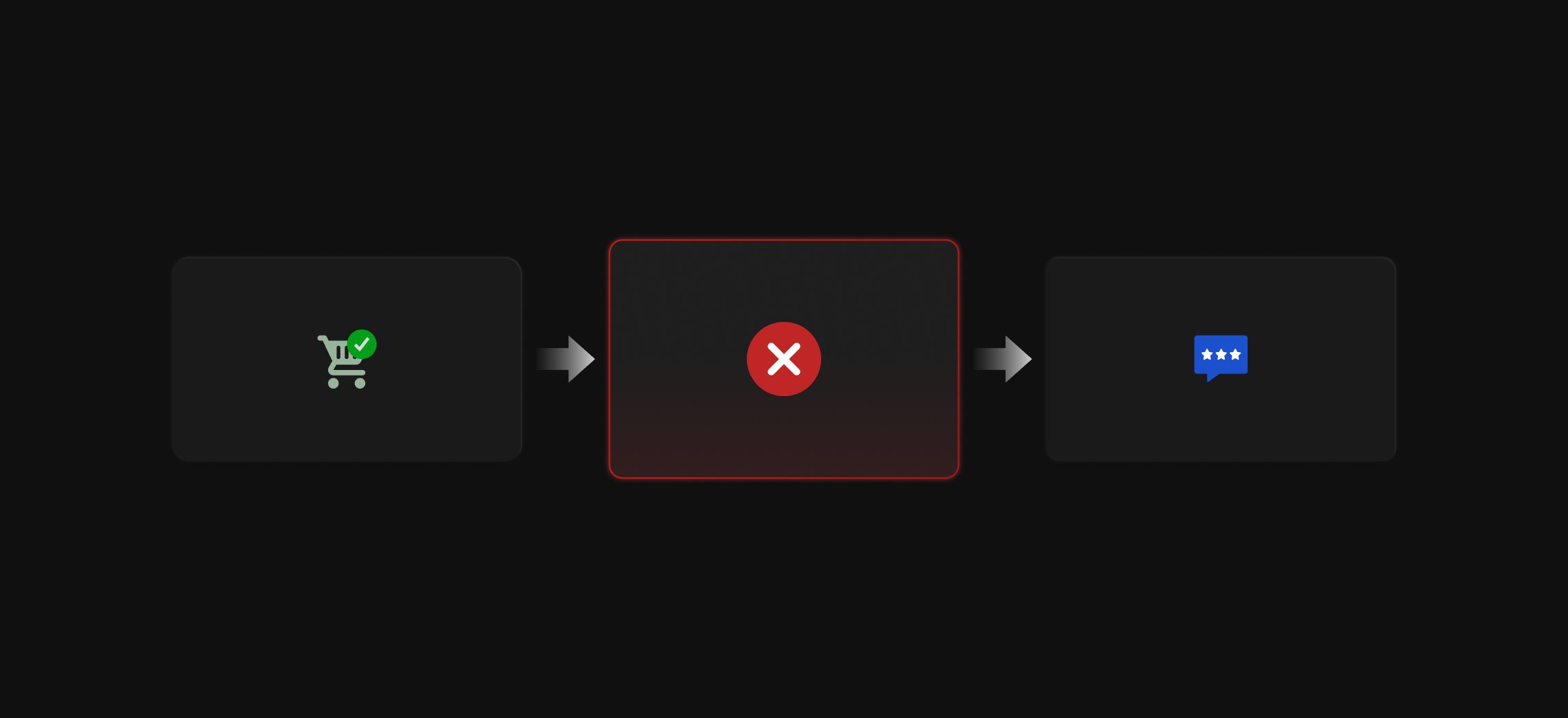

Customer reviews are often one of the first things people look for when shopping online. A quick review of recent customer comments, along with a star rating, can help determine the trustworthiness of a business. Our recent SmartCustomer study found that for nearly all consumers, online reviews are an essential part of making purchase decisions.
But what if the customer reviews don’t tell the complete story?
Consumer reviews can be compromised by fictitious accounts posting glowing five-star ratings or competitors leaving malicious one-star reviews. However, the biggest threat to an honest online reputation isn’t always the fake reviews, but the unseen reviews. The reviews that go unwritten or the reviews that customers are pressured to edit or remove can be quietly influential.
At SmartCustomer, our moderation team analyzes reports from both consumers and businesses. To help ensure reviews reflect authentic customer experiences, we investigate reports of review manipulation and suspicious review collection practices and look for policy violations.
The overwhelming majority of businesses collect and publish reviews in good faith. They solicit and share genuine feedback, both positive and negative, because it helps them improve and build trust with future customers.
Unfortunately, not every business takes that approach. Here are a few of the most common ways an online reputation can become distorted by unseen reviews.
When Customer Service Comes with Strings Attached
One way that unseen reviews impact reputation is when a business only addresses an issue if the customer removes or edits a review. For example, say a consumer orders a product that arrives damaged. She contacts customer support to explain the issue and leaves an honest review describing her experience.
But the business’s response includes caveats. For example, they might respond with, "We’ll gladly issue your refund once the review has been removed,” or “If you update your review, we’ll send you a replacement.”
These types of conditional responses can create an uncomfortable dilemma for the customer. Should she change her review to get the basic customer service the company should be providing anyway, without conditions? Or should she keep her honest review online and risk not receiving the resolution she deserves?
Reviews should reflect the customer’s actual experience. Resolving issues should never be contingent upon changing or removing an honest review.
The Federal Trade Commission, or FTC, has taken an increasingly strong stance against practices that distort online reviews. Requiring customers to change or remove truthful reviews in order to receive refunds, replacements, discounts, or other compensation may violate the FTC Act because it can mislead future consumers about a business’s reputation. The FTC has also adopted rules targeting review suppression and other deceptive review practices.
If a business asks you to remove or alter an honest review in exchange for compensation or as a condition of resolving a complaint, keep copies of all communication, such as emails or text messages. Report the incident to the review platform where the review was posted so it can be investigated. You might also consider filing a complaint with the FTC.
Documented Case
In one case reported to SmartCustomer’s moderation team, a customer shared her attempt to resolve an issue with a business after she’d posted public complaints about the company. A company representative responded that they were “waiting on [her].” They noted that rather than posting additional replies, the customer could have spent 30 seconds resolving her issue so the company could “proceed with [her] payout.”
The customer service representative added, “The sooner you cooperate with us versus threaten us… the sooner we can proceed.” The correspondence included links to the customer’s public posts, including a SmartCustomer review.
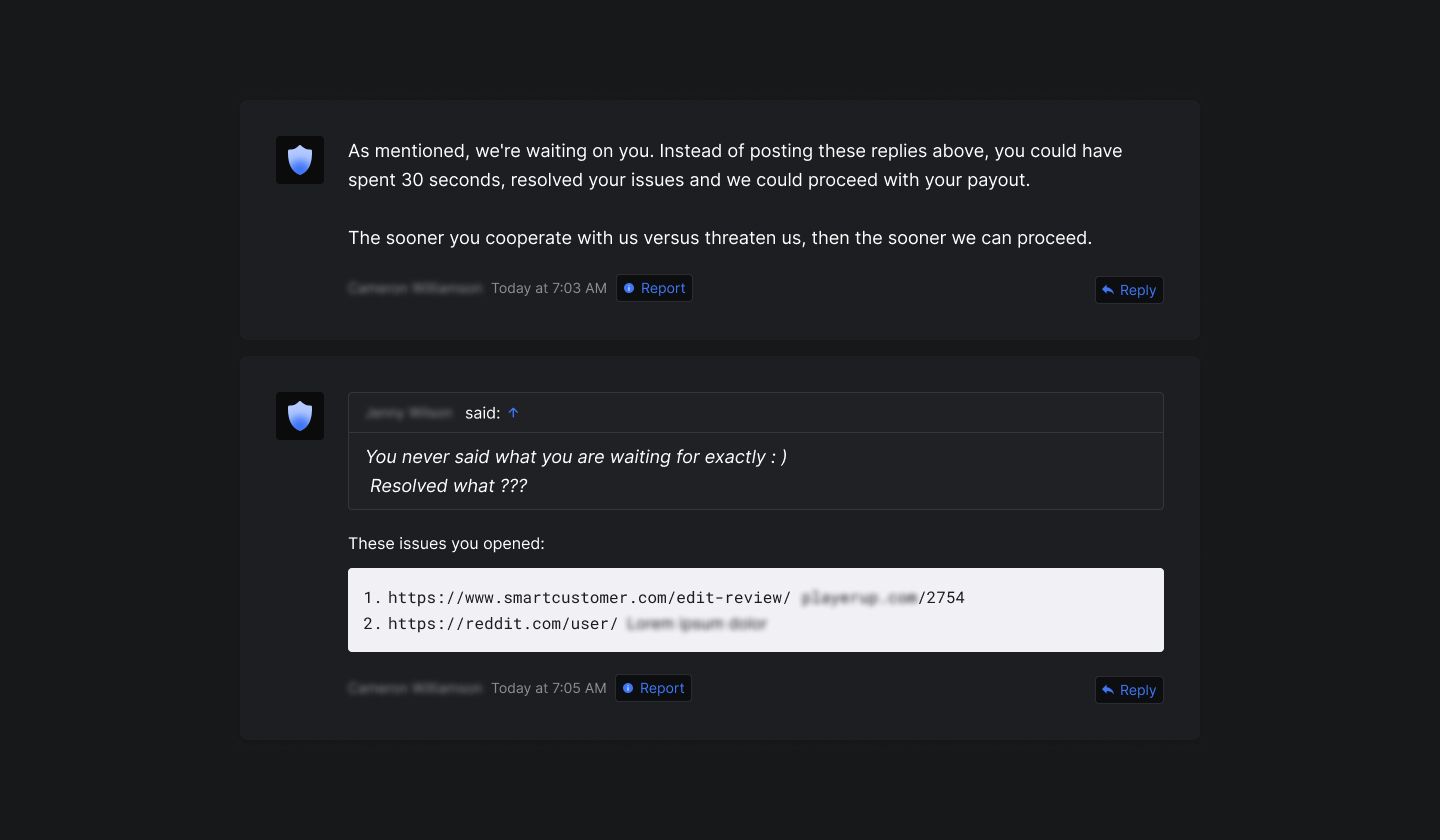 This exchange illustrates how businesses may pressure customers to edit or delete a review to resolve an unrelated dispute. Consumers shouldn’t have to choose between maintaining an honest account of their experience and getting a business to address a legitimate problem.
When reports like these are submitted to SmartCustomer, our moderation team reviews the available evidence, including such supporting documentation as screenshots and emails. If we determine a business has attempted to manipulate or suppress honest customer feedback in violation of our policies, we take appropriate action.
When Only Satisfied Customers Are Invited to Share Their Experience
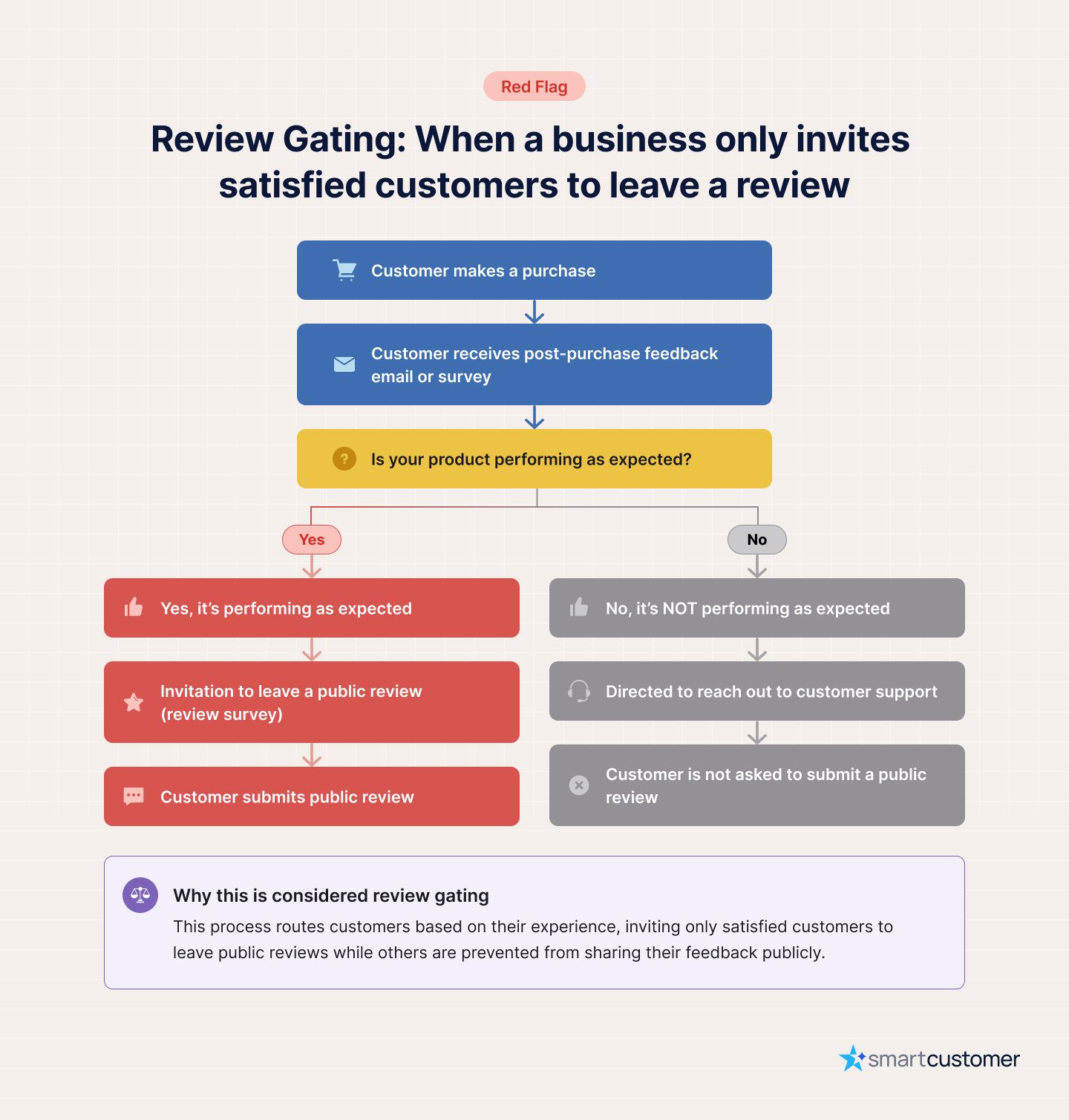
A business can also strategically collect and share reviews only from customers who have had positive experiences. For example, say two customers purchase the same product. Customer A has a wonderful experience, while Customer B experiences shipping delays or receives a defective product. Customer A receives an invitation encouraging her to leave a public review. Customer B is instead directed to customer support and never receives a review request.
Over time, this business develops a review profile filled almost exclusively with satisfied customers. Even though there are no fake reviews or false information, consumers still see an incomplete picture.
This practice, often referred to as “review gating,” creates a public reputation that doesn’t accurately represent the experiences of all customers. One of the principles behind trustworthy reviews is that every customer should have an equal opportunity to share honest feedback, regardless of whether that experience was positive or negative. In this case, the business doesn’t necessarily have fake reviews. But only certain customers are targeted in order to guarantee positive reviews.
Documented Case
In one case documented by SmartCustomer, a business used a post-purchase feedback process that routed customers differently based on their experience. Customers who indicated that their product was performing as expected were invited to leave a public review, while customers reporting problems were directed to customer support instead.
When SmartCustomer discovered the gated process, we removed all reviews submitted during the biased solicitation period. Although the posted reviews may have reflected genuine experiences, the process didn’t give all customers the opportunity to share their experience publicly.
When a Review Request Isn’t What It Seems
Businesses must send review invitations to real customers, which ensures that every review reflects an authentic experience and transaction. If businesses upload fabricated customer lists or send review requests to people who never made a purchase, it undermines the integrity of the entire review process.
At SmartCustomer, businesses that use our review collection tools are required to invite real customers based on genuine transactions. When something about a customer upload or review invitation campaign appears unusual, our moderation team may review it more closely to ensure it complies with our policies.
Not every unusual pattern necessarily points to wrongdoing. For example, businesses might migrate to new systems or experience legitimate spikes in sales. The goal isn’t to assume the worst but to ensure that review invitations are tied to authentic customer experiences.
Documented Case
In one case, a business submitted a large customer list for review invitations that raised concerns during moderation. SmartCustomer asked the business to provide documentation showing that the individuals were genuine customers with legitimate transactions, but they never provided the requested evidence.*
*As a result, we removed the reviews generated from the campaign. Without evidence that the underlying customers were legitimate, we couldn’t verify that the reviews were based on genuine customer experiences.
By verifying review collection practices before reviews are published, we help protect consumers from seeing feedback that may not accurately reflect real customer experiences. Long before a review appears on a business profile, the integrity of the process depends on ensuring the invitation reaches a real customer. This approach is one of the many ways review integrity begins before a customer ever submits a review.
Learn more about the patterns behind fake reviews and how we detect them here.
When Businesses Pressure Customers After the Review Is Posted
Sometimes a business initiates contact with a customer who posts an unflattering review. A customer may receive repeated emails asking them to reconsider posting their review or be told that their feedback is unfair or hurting the business. In some cases, businesses continue contacting customers long after the issue has been resolved, hoping they’ll eventually remove or revise their review.
While it’s perfectly reasonable for a business to respond to feedback or ask questions about a customer’s experience, consumers should never feel harassed or pressured into changing an honest review. Great customer service often leads customers to voluntarily update their reviews, but that decision should always be up to the customer, not the business.
Documented Case
In one documented example, a business owner contacted a customer after she posted a negative review. The owner noted that the review could have significant adverse effects on the company’s reputation and future and repeatedly asked the customer to reconsider sharing it.
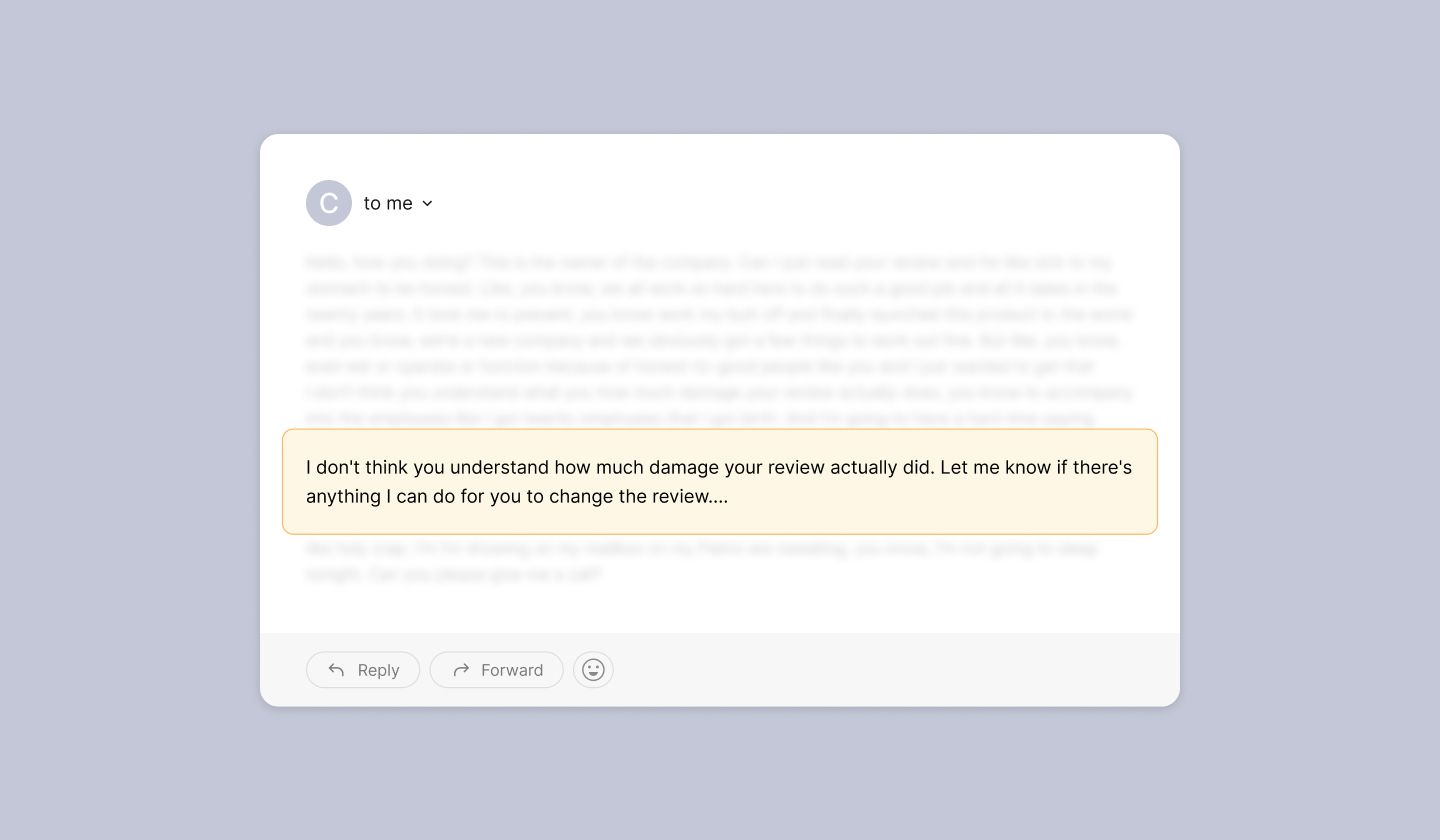
A customer should always be able to decide whether to keep, revise, or remove an honest review without any pressure from the business.
When Businesses Use Legal Threats to Silence Reviewers
Sometimes the pressure to remove a review goes beyond repeated emails or requests to reconsider and involves demands and threats. In some cases, a business might claim that the consumer’s defamatory comments have damaged the business’s reputation and is considering pursuing legal action.
The threat of a lawsuit can be intimidating. A customer may decide that keeping an honest review online isn’t worth the stress or expense even when their review accurately describes their experience.
Businesses do have legitimate rights when they believe a review contains false statements or otherwise violates the law. A business can pursue a legitimate legal claim when it has a reasonable basis for doing so. But using an unfounded or groundless legal threat to scare a customer into removing a legitimate negative review is a different matter.
The FTC’s Consumer Reviews and Testimonials Rule specifically prohibits businesses from using unfounded or groundless legal threats to prevent consumers from posting negative reviews or to cause existing reviews to be removed.
The Consumer Review Fairness Act provides additional protection for consumers. The law prohibits businesses from using contract provisions that restrict honest reviews or impose penalties on consumers for posting them. The FTC specifically notes that provisions threatening consumers with legal action for posting negative reviews can violate the law.
This distinction matters. A legal complaint isn’t automatically evidence that a review is fake, and a business’s threat to sue doesn’t automatically mean that a review violates a review platform's policies. When these situations are reported to SmartCustomer, our moderation team evaluates the review and available evidence independently rather than treating the existence of a legal threat as proof that the review should be removed.
Consumers who receive a legal threat related to a review should save the original review and keep copies of any emails, letters, messages, or other communications they receive. If a business claims that a review is defamatory or otherwise unlawful, consumers might also consider seeking independent legal advice about their specific circumstances.
Documented Case
In one case reported to our moderation team, a job seeker left a negative review describing their experience interviewing for a position with a recruitment company. The reviewer provided specific details about the interview and explained why they ultimately decided they were no longer interested in working for the company.
After posting the review, the reviewer contacted us to report that the business had demanded that they remove it and threatened legal action if they didn’t comply.
The email from the business stated that the review contained “defamatory content” and demanded that it be removed within 24 hours. It went on to warn that the company’s legal team could pursue legal action and seek €25,000 in compensation for alleged damages.
The user noted the review was based on their personal experience and that they felt they were being threatened because they’d shared a negative account of the interview. When a report like this reaches SmartCustomer, our moderation team evaluates the review against our policies and considers the available evidence. The goal is to protect legitimate customer feedback but also take appropriate action when we find that a review violates our rules.
In another documented example, a customer posted a negative review describing concerns about a product, its marketing, and the business’s handling of a return request. After the review was published, the business sent the customer messages demanding that the review be removed and threatening legal consequences if the customer didn’t comply.
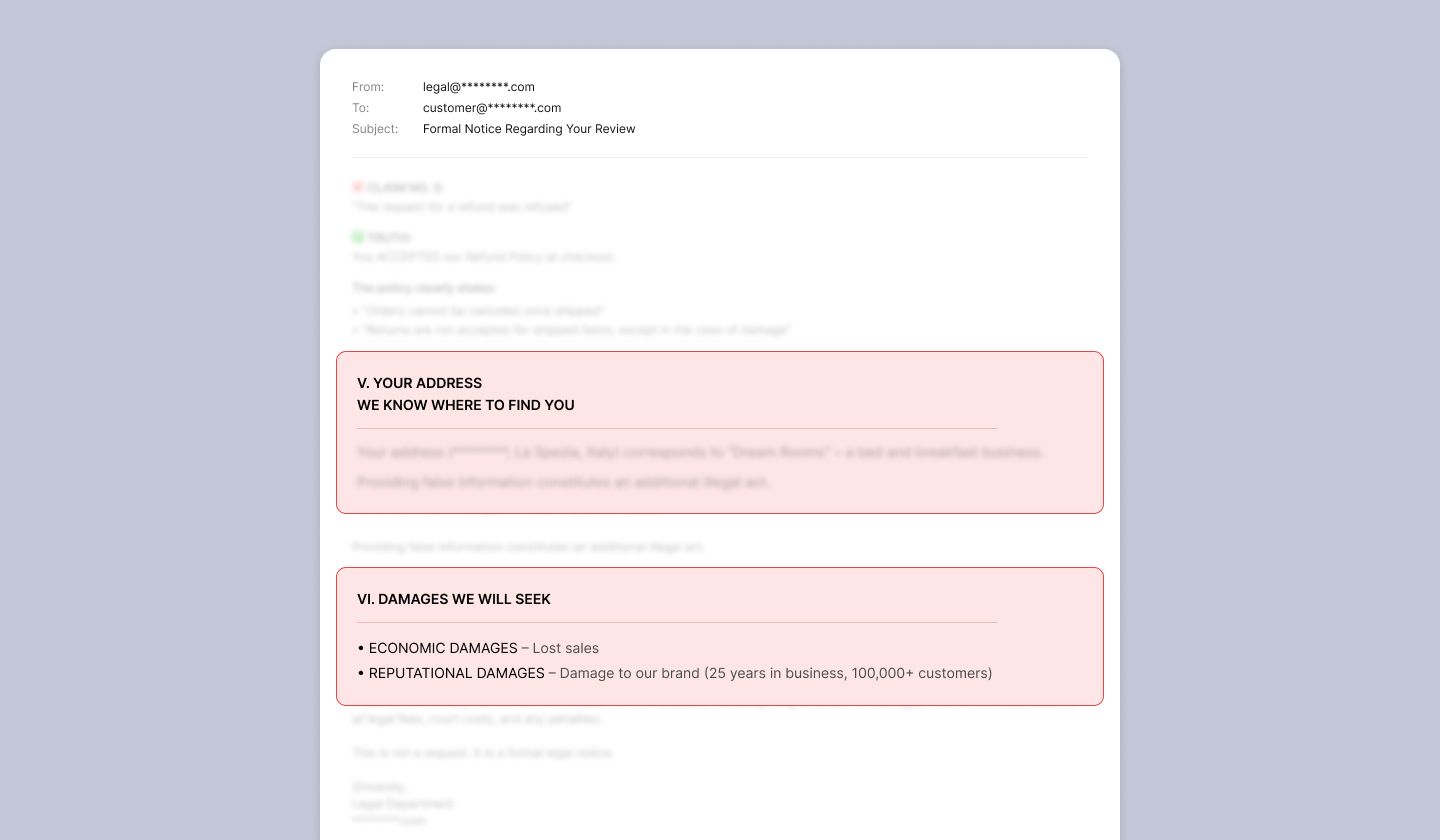
The messages included several distinct red flags: explicit references to the customer’s physical address, threats of legal action, and claims of potential financial liability. Rather than addressing the feedback, the business characterized the review as inherently harmful and indicated it was prepared to pursue aggressive legal action—a classic tactic used to pressure consumers into silence.
What Happens Behind the Scenes
Most consumers never see what happens after someone reports a review or a business. Behind every report is a moderation process designed to balance two important goals: protecting consumers from deceptive practices while preserving honest customer feedback.
At SmartCustomer, reports may be created by consumers, businesses, or our internal review processes. For each report, our moderation team reviews the available information and determines whether additional investigation is needed.
Depending on the situation, that review may include:
- Reviewing supporting documentation provided by the customer or business
- Evaluating communications between the parties
- Confirming that a reviewer meets our eligibility requirements
- Determining whether review collection practices comply with our policies
Each case is evaluated individually. Not every report results in action, and not every complaint indicates misconduct. Our goal is to preserve the integrity of the review ecosystem by ensuring reviews accurately reflect genuine customer experiences.
To learn more about the standards, safety checks, and verification processes that inform our platform, check out our Trust Hub.
Why Honest Reviews Matter
Online reviews help people decide where to spend their money and determine which businesses deserve their business. That trust only exists when reviews represent real customer experiences.
Most businesses work hard to earn positive feedback through quality products and honest, responsive customer service and engagement with their customers. Those businesses deserve to compete on a level playing field.
Consumers deserve confidence that reviews weren’t influenced by pressure or selective solicitation or other practices that distort the full picture.
While no review platform can prevent every attempt to manipulate reviews, maintaining a trustworthy review ecosystem requires honest, thoughtful moderation and a commitment to protecting authentic customer voices.
Trust is built by giving every legitimate customer an equal opportunity to share an honest experience, regardless of whether it was positive or negative.