



Shoppers don’t trust AI. They use it anyway — and 1 in 3 regret it.
In August 2026, SmartCustomer surveyed 1,181 U.S. consumers to understand how AI is changing the way people shop and the degree to which they trust its recommendations. Our survey found that many shoppers are increasingly turning to AI to make purchases even though most don’t fully trust AI’s recommendations and are wary of online businesses in the AI era.
Key findings at a glance
-
Few online shoppers completely trust AI shopping.
89% of consumers don’t fully trust AI's shopping recommendations; however, most don’t reject it outright. Nearly half (47%) report that they “trust [it] a little” and more than a quarter (28%) trust it “a lot.” -
Despite concerns, AI usage for shopping is increasing.
Even though most respondents don’t fully trust it, the majority (76%) used AI to shop in the past year, and half (50%) expect to use it even more over the next 12 months. -
Shoppers are regretting AI purchases.
About a third (33%) of respondents regret an AI-recommended purchase, with millennials being the age group most trusting of AI and also the most likely to regret an AI purchase (45%). -
Despite relying heavily on AI recommendations, online shoppers still worry about their authenticity.
Nearly three-quarters (75%) of respondents double-check AI’s recommendations, mostly through reviews and their own research (versus using AI). -
Being scammed is a shopper’s biggest fear.
About half (51%) of respondents are very or extremely concerned about AI recommending scams or fraudulent sellers, and this concern ranks above all other listed risks. -
Shoppers think businesses are gaming AI.
More than half (54%) of respondents believe businesses are feeding AI false or misleading information to influence its recommendations. -
Shoppers want accountability for AI companies’ recommendations.
Nearly all (98%) of respondents want AI companies to share accountability for their recommendations. -
AI shopping usage varies by gender.
Female survey respondents report using AI for shopping at a statistically significant lower rate than males (53% of females versus 63% of males) and opt out of AI shopping entirely at a statistically significant higher rate than males (23% of females versus 15% of males). -
AI shopping adoption doesn't rise and fall with age — it peaks in the middle.
The 18- through 29-year-old cohort holds out at a rate statistically indistinguishable from 45- through 60-year-olds — a generation usually assumed to be far less AI-comfortable.
1. Consumers don’t fully trust AI shopping recommendations
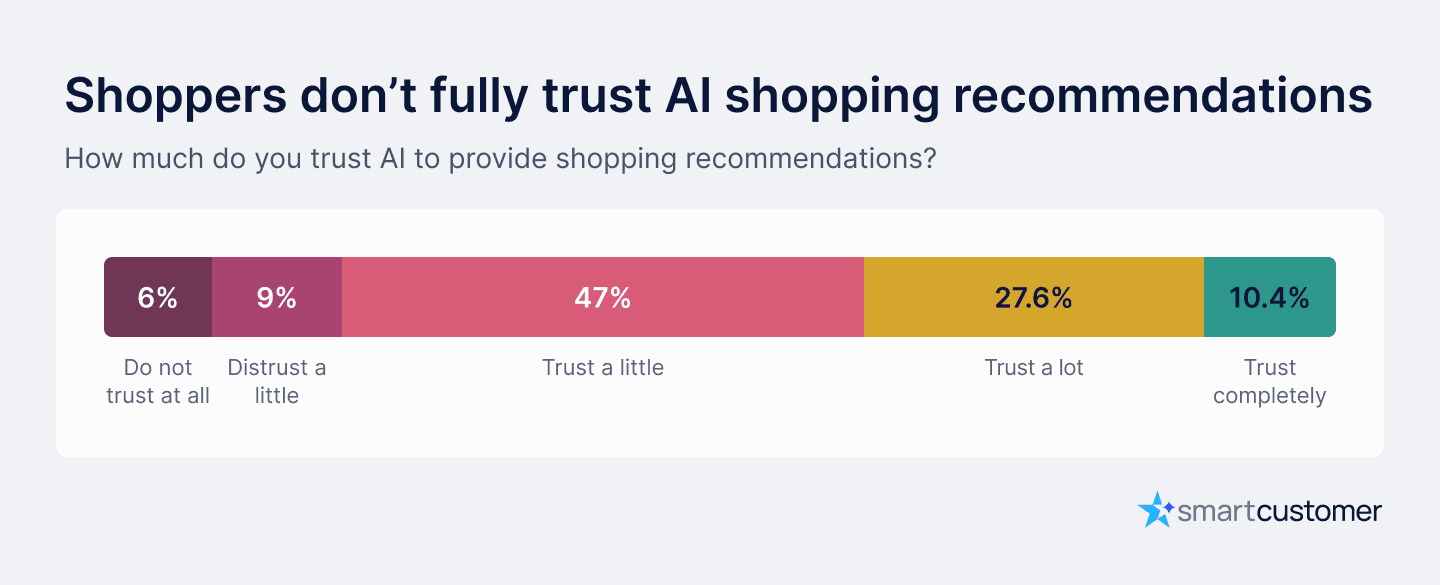
89% of shoppers say they don't fully trust AI's product recommendations. Only a small minority (11%) of survey respondents completely trust AI’s shopping recommendations; however, most have not ruled it out entirely. Nearly half (47%) report that they “trust [it] a little” and more than a quarter (28%) trust it “a lot” rather than reject it outright.
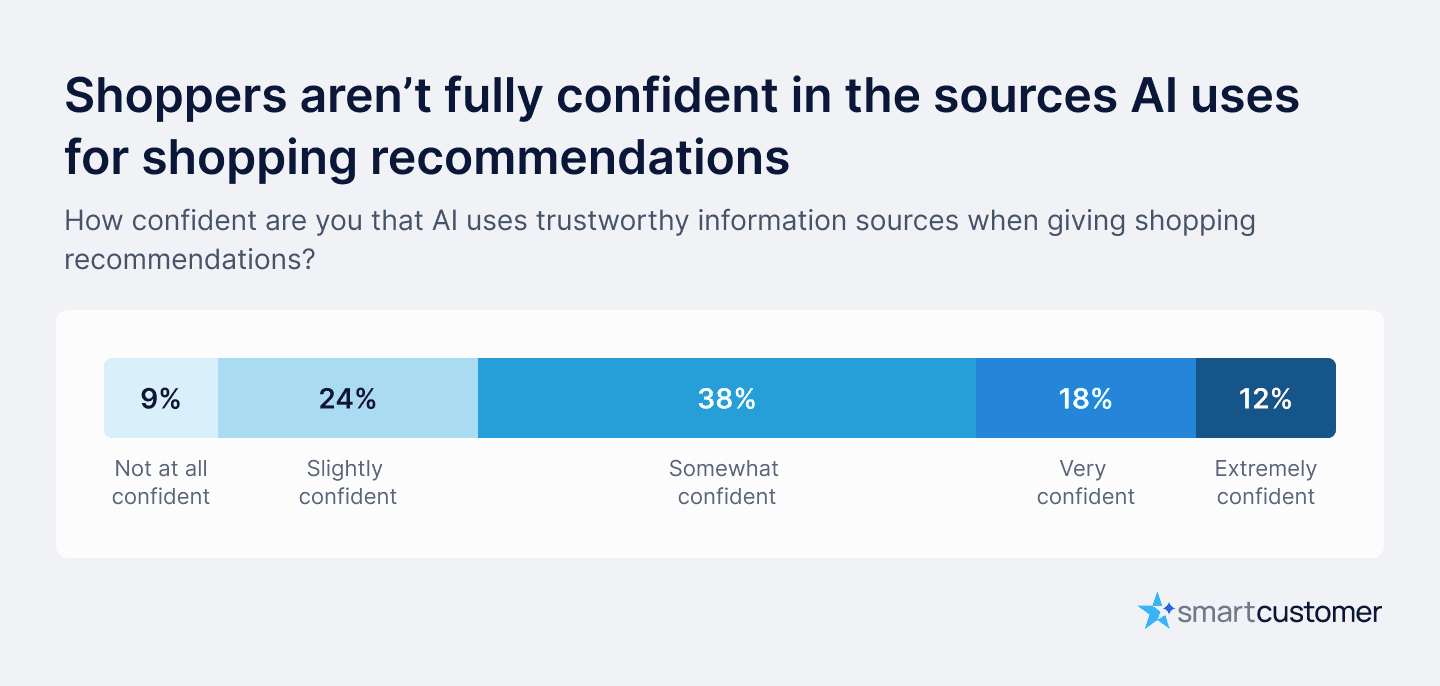
Our survey found a similar pattern for shoppers’ confidence in the sources AI uses to form shopping recommendations. Less than a third of consumers (29%) feel very or extremely confident that AI draws on trustworthy information sources.
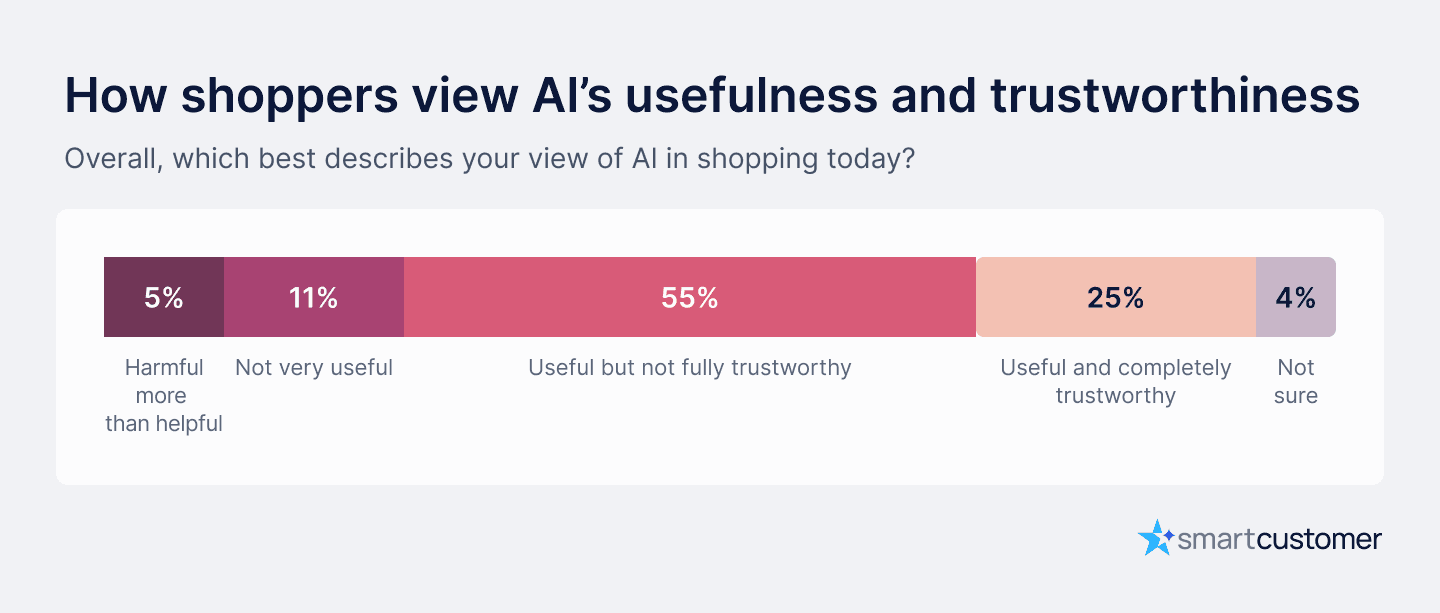
When asked to sum up their overall view of AI in shopping, 55% called it useful but not fully trustworthy, while 16% don’t think AI is useful to help make purchasing decisions at all.
Impact: Consumers aren’t rejecting AI outright. Most are planning to increase their usage, but are still deciding whether it deserves more trust. For businesses, that means getting recommended by AI models is crucial, as it's a primary way customers will be making purchasing decisions. However, AI’s growing role in shopping doesn’t always earn it automatic credibility. Even as more customers browse and comparison shop with AI’s help, they’re still deciding whether to believe what it tells them. In short, a business’s reputation and evidence still matter as much as ever.
2. Despite concerns, shoppers are increasingly using AI anyway
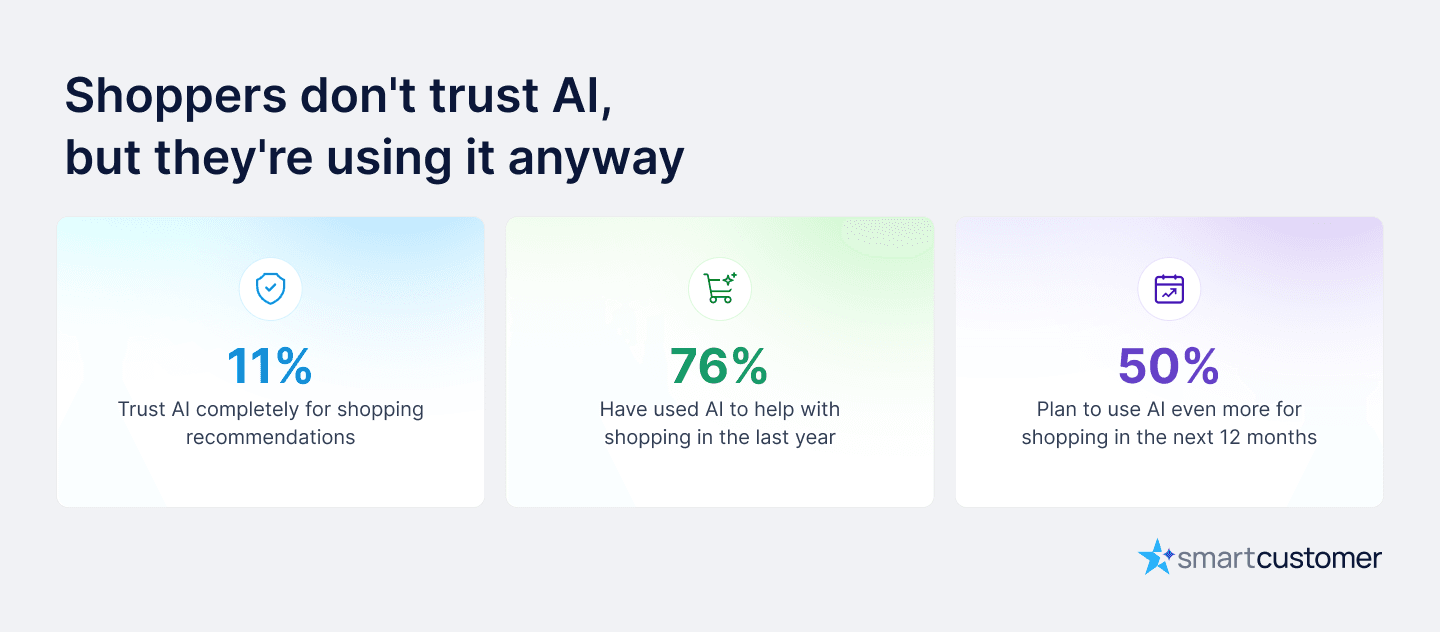
Even with an ongoing trust gap, AI has become a routine part of how people shop. 76% of Americans used AI to help with shopping in the past year. 36% reported using AI to shop “often” or “very often” in the past 12 months, and 53% say they’re using it more than they were a year ago.
Growth in usage shows no sign of slowing. When asked how their AI use will change over the next year, as much as half of the population (50%) expect to use AI somewhat or much more going forward.
Impact: Shoppers’ adoption of AI is outpacing their confidence in it. In other words, consumers are using AI for shopping well before they’ve decided to fully trust it.
3. AI is giving shoppers bad recommendations, and the most trusting shoppers are getting burned the most
AI’s growing role in shopping comes with a real cost. A third of consumers (33%) have made a purchase based on an AI recommendation that they later regretted. Electronics top the list of regretted purchases (50%), followed by clothing and shoes (45%) and beauty or personal care products (33%).
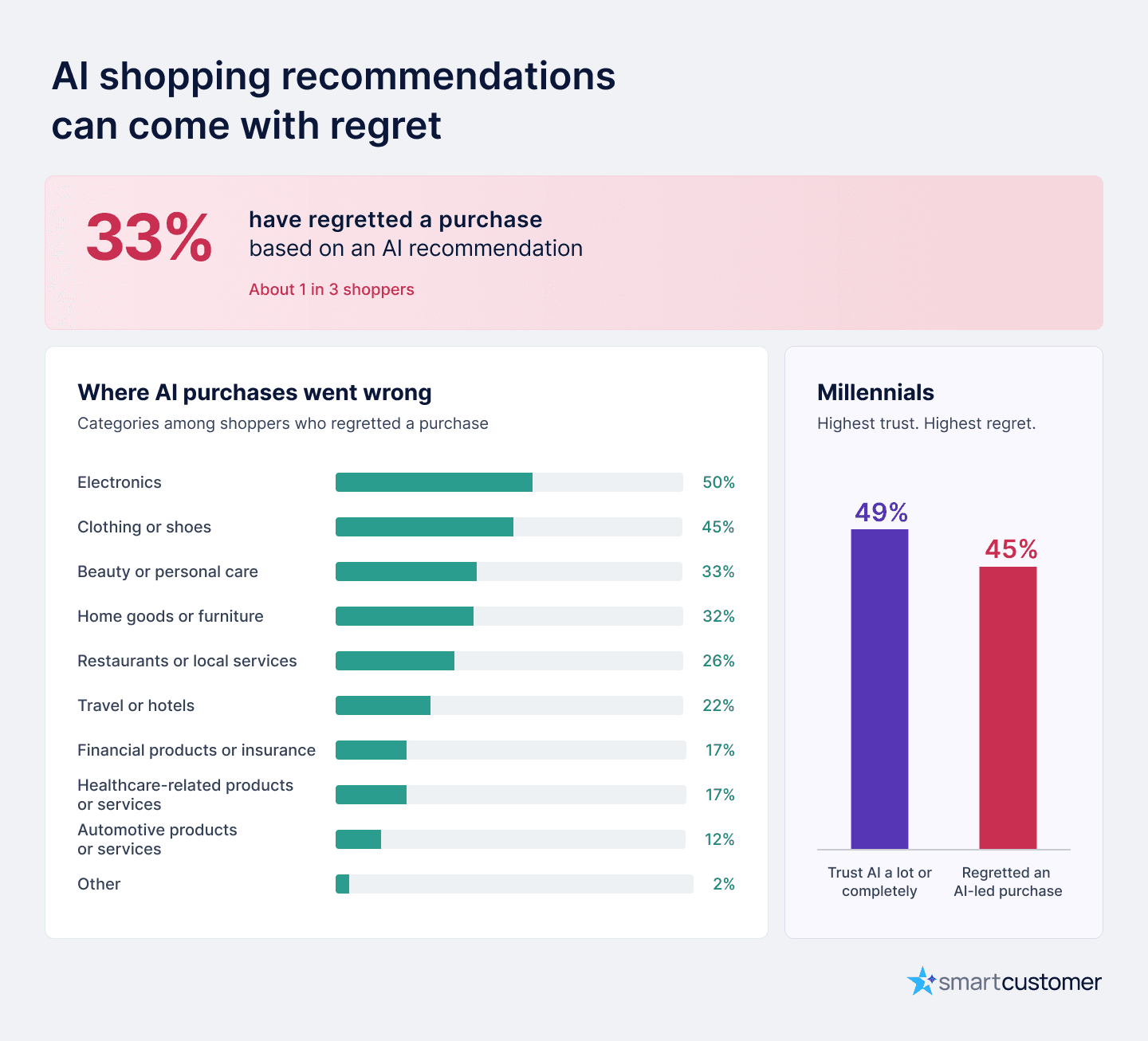
The group most willing to follow AI’s advice is also the group most often burned by it. Millennials ages 30 through 44 are both the most likely to have regretted an AI-recommended purchase (45%) but also the most trusting of AI overall (49% trust it “a lot” or “completely”).
Impact: The recommendations AI provides to consumers are not always trustworthy. A substantial percentage of shoppers have had negative experiences following AI recommendations. The shoppers most willing to act on AI’s advice are also the most vulnerable when it gets something wrong.
4. Shoppers verify AI’s recommendations, mostly without AI’s help
Most consumers who use AI are verifying information before making purchasing decisions. Nearly three-quarters (75%) of consumers verify AI shopping recommendations at least sometimes before acting on them, with 43% verifying most or all of the time.
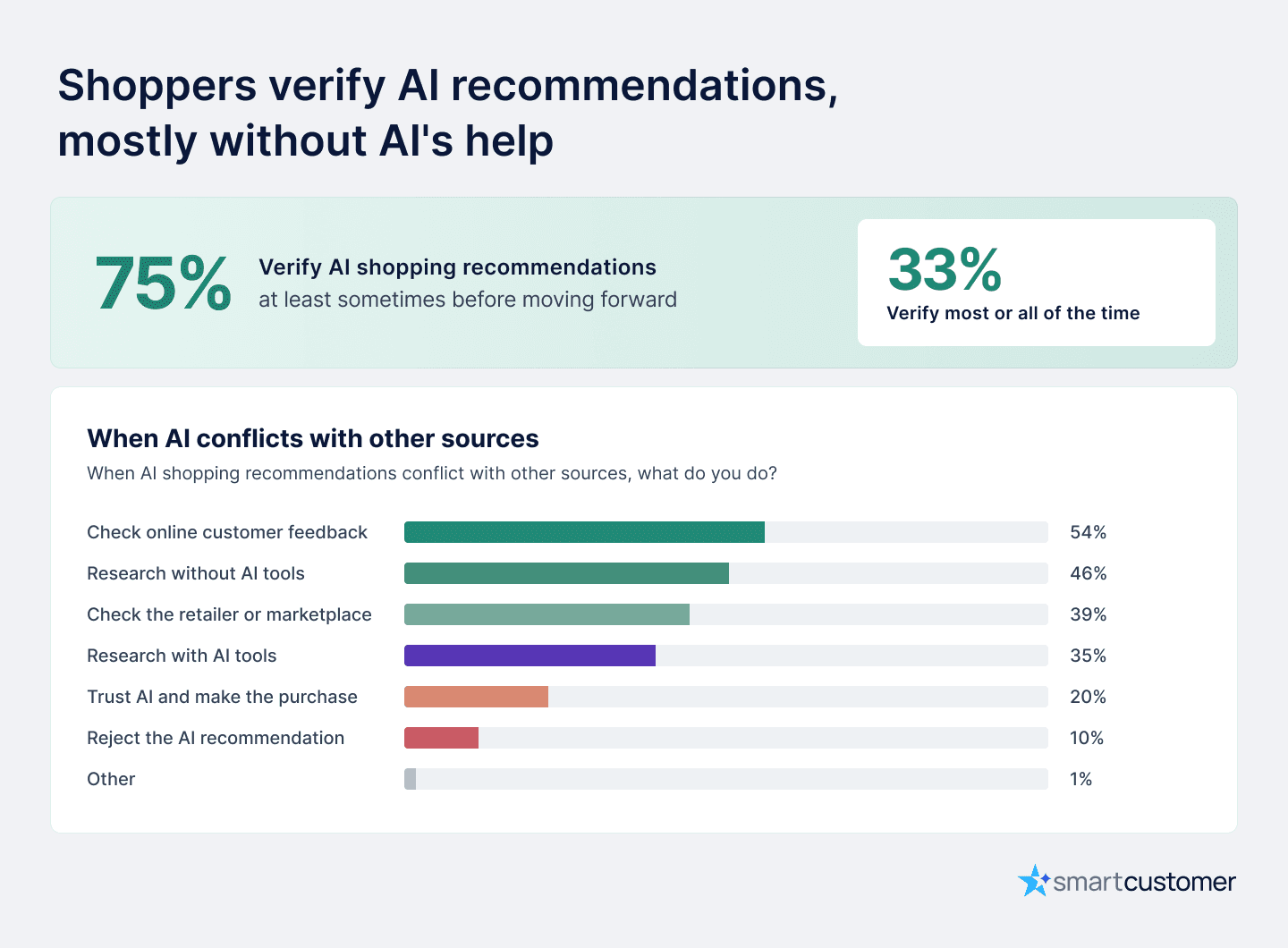
When an AI recommendation conflicts with another source, checking online customer feedback is the most common response (54%), followed by conducting more research without AI tools (46%), and checking directly with the retailer (39%). About a third of consumers (35%) turn to AI tools to conduct additional research. Only about a fifth (20%) say they’d trust the AI recommendation and buy the product anyway.
Impact: An AI recommendation isn't the only determining factor for consumers. Consumers treat AI as one opinion among many. When something feels off, they consult reviews and the retailer directly rather than asking AI to double-check itself. Consumer reviews and website content impact whether the sale happens.
5. Reviews are the backbone of AI-era shopping, and shoppers fear they’re being faked
Even as AI becomes deeply embedded in everyday shopping, customer reviews still dictate buying choices. Nearly all consumers (94%) rely on reviews to make a purchase decision at least sometimes, and more than two-thirds (68%) read reviews often or very often before buying.

Shoppers don't take AI's word alone, either. Of the 75% verifying AI shopping recommendations against other sources at least sometimes, customer reviews are their second most common method (56%), behind only search engines (64%) and far ahead of asking friends or family (33%).
At the same time, consumers worry that the reviews feeding AI's recommendations aren’t real. A large majority (83%) are at least moderately concerned about fake reviews skewing AI shopping recommendations, and more than half (53%) are very or extremely concerned.

Impact: Even with AI in the mix, shoppers are leaning on customer reviews, both to make purchase decisions and to double-check what AI recommends. But a large majority worry about the prevalence of fake reviews online and how much that impacts the quality of AI recommendations.
Additionally, for businesses, managing reviews matters on two fronts: getting recommended by AI models, and reaching the shoppers who verify those recommendations against reviews before they buy.
6. Getting scammed is shoppers’ single biggest fear about AI recommendations
Scams and fraudulent sellers are the primary concerns consumers have about AI shopping recommendations. About half of survey respondents (51%) say they are very or extremely concerned about it. Respondents are also very or extremely concerned about poor-quality businesses (46%), a lack of transparency about why something was recommended (45%), not enough information to judge a recommendation (44%), and recommendations built on false or outdated information (43%). Concern about algorithmic bias ranks last (32%), trailing every other concern by double digits.
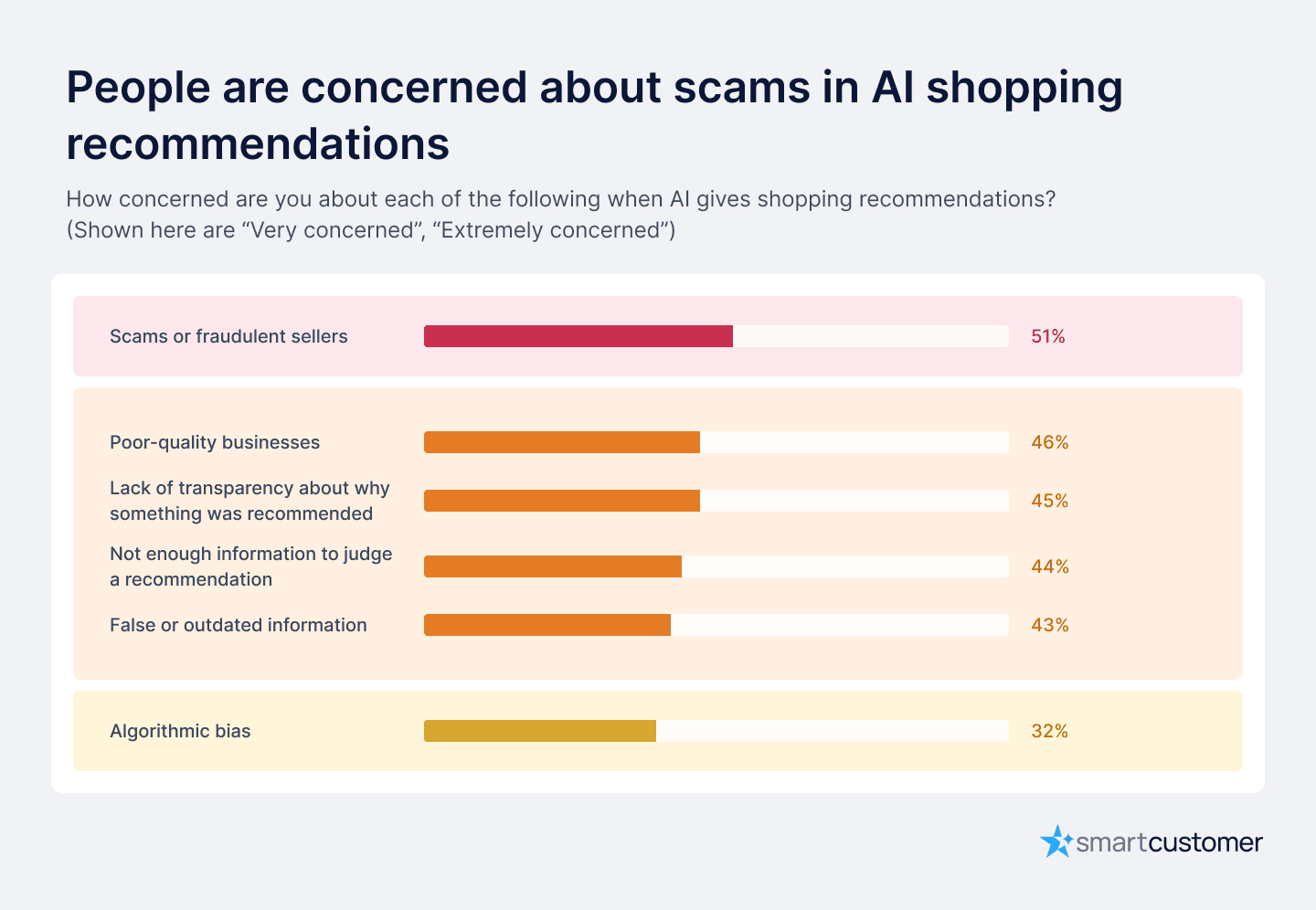
Impact: With the presence of AI in modern retail, scams remain a widespread threat. Shoppers are more worried about engaging with a fraudulent seller than data-driven bias.
7. Consumers think businesses are gaming AI's recommendations
Consumers don’t just doubt AI itself. A majority of respondents (53%) agree that businesses are strategically providing false or misleading information to influence AI shopping recommendations.

Impact: Consumers are skeptical not only of AI itself, but of the businesses trying to game its recommendations. With a third of shoppers already regretting an AI-driven purchase, this spillover distrust hits honest brands too. In this environment, it’s vital for brands to increase transparency around their operations, pricing, and proven value.
8. Consumers want AI companies to be held accountable and provide justification and sources for recommendations
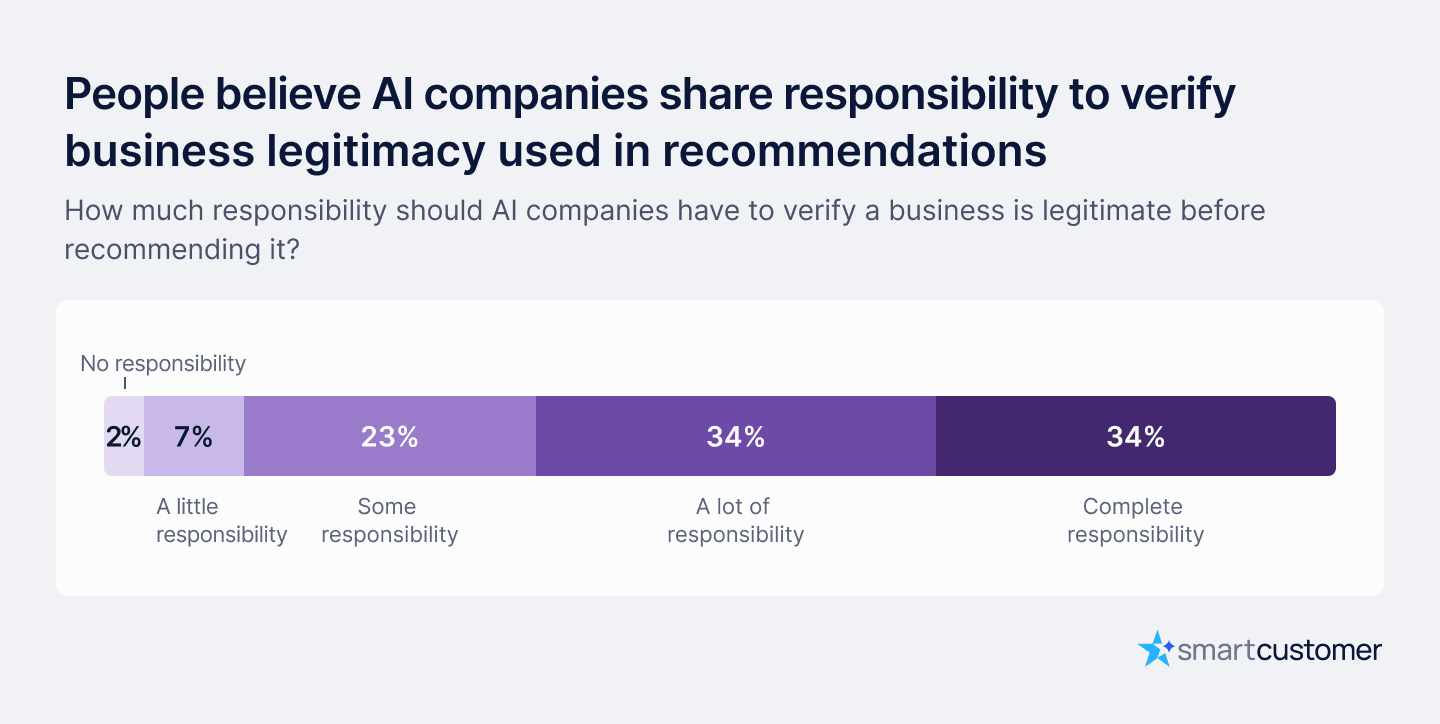
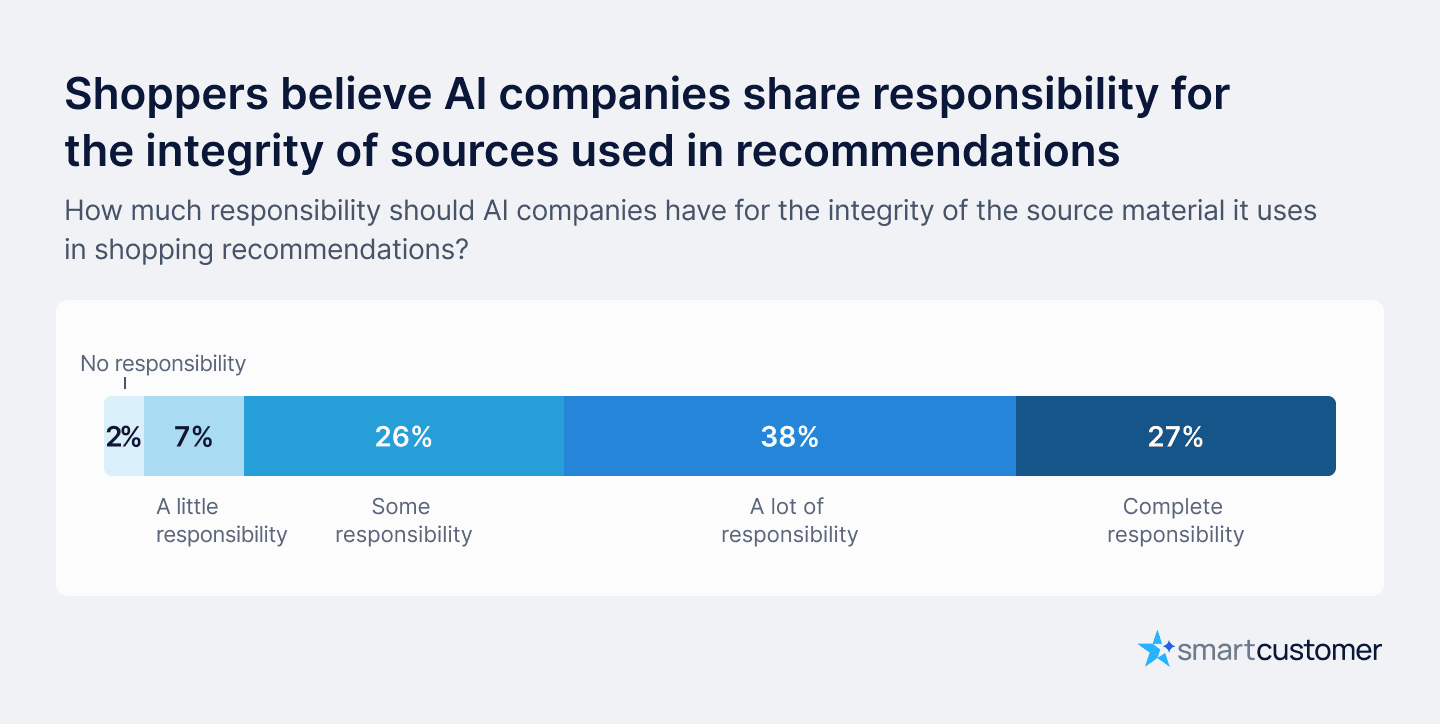
Consumers are clear about who should be responsible for AI shopping tools’ recommendations. Almost all respondents believe AI companies share responsibility for both source integrity (98%) and verifying business legitimacy before making recommendations (98%). In fact, roughly two-thirds place "a lot" or "complete" responsibility on AI companies for both source quality (65%) and business verification (68%).
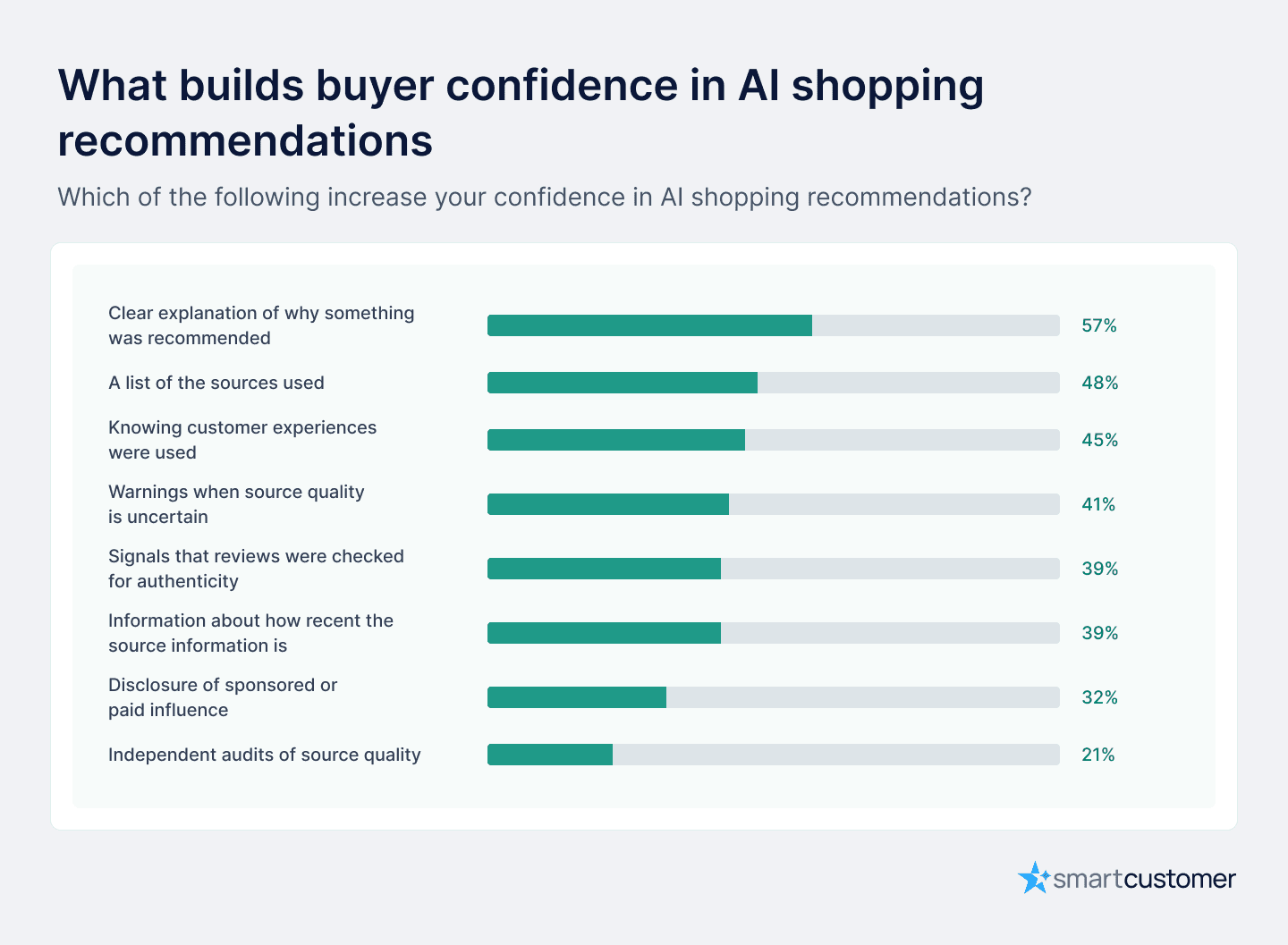
Consumers also reported what would rebuild their trust. More than half (57%) wanted a clear explanation of why something was recommended. Nearly half wanted a list of the sources used (48%) and confirmation that customer reviews were factored into the answer (45%). More than a third (41%) wanted the companies to post warnings when the source quality is uncertain.
Impact: Consumers overwhelmingly want AI companies to be held accountable for what they recommend, both for the integrity of their sources and for verifying that a business is legitimate before providing it as an option. Shoppers don't think they are completely responsible for evaluating AI recommendations; they expect the AI companies like OpenAI, Google, Anthropic, and Meta to do due diligence on their behalf.
9. Usage varies by gender and age
Women, people aged 60 and over, and Gen Z report lower rates of AI shopping use than men and Millennials.
Women are using AI shopping tools less than men
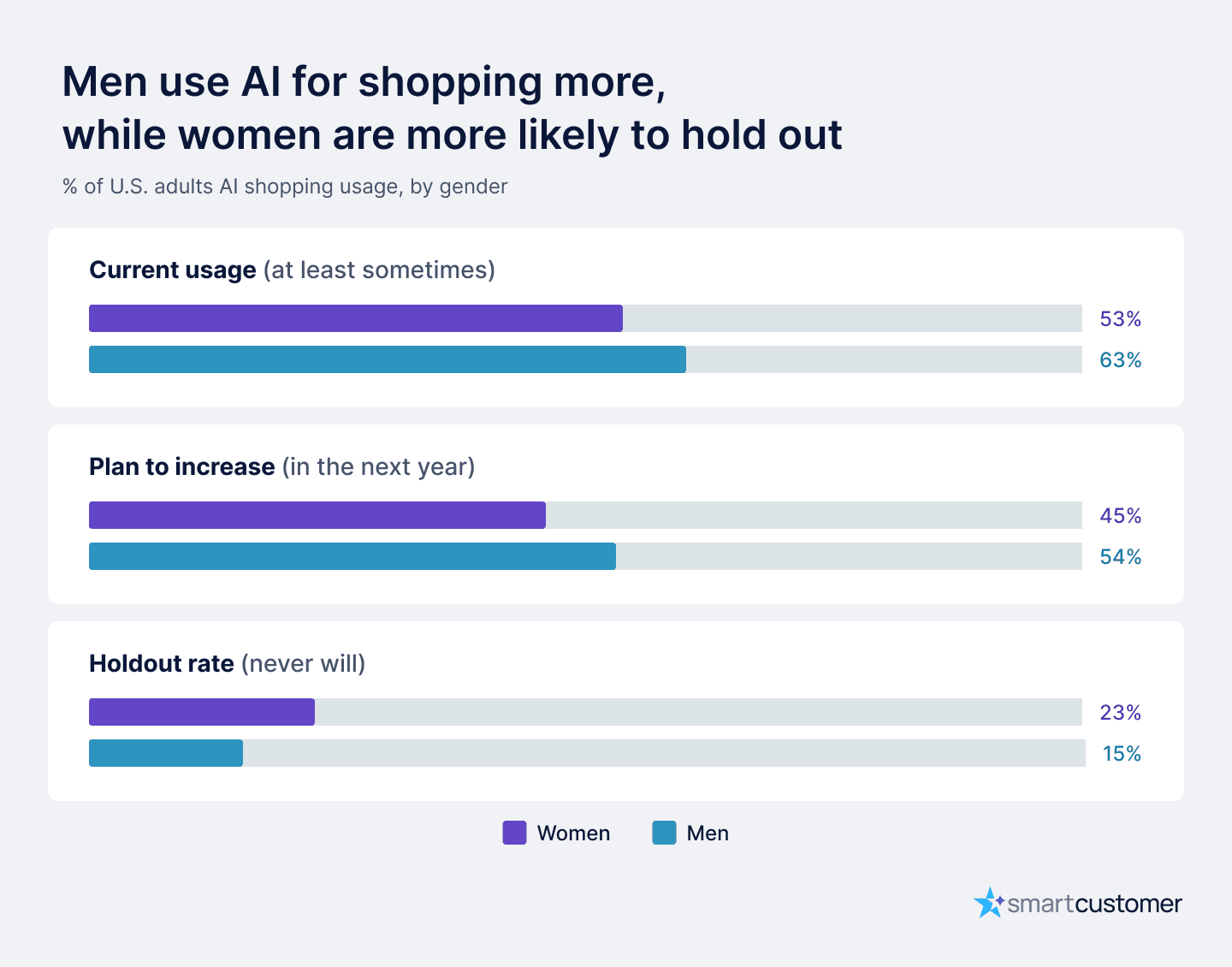
Women currently use AI for shopping less often than men (53% at least sometimes compared to 63% for men), plan to increase their use at a lower rate (45% compared to 55%) and are opting out of AI shopping entirely at a higher rate (23% of women say they never intend to use it, compared with 15% of men). All three gaps are statistically significant.
And though this next difference isn’t statistically significant, it’s worth noting that female survey respondents reported distrusting AI more (16%) than male respondents (12%), which might be one reason for the lower rates of AI use among women. This gap aligns with another recent survey, which found a consistent pattern in which women tend to view AI more negatively than men (Pew Research Center, 2026).
AI shopping adoption doesn't rise and fall with age — it peaks in the middle.
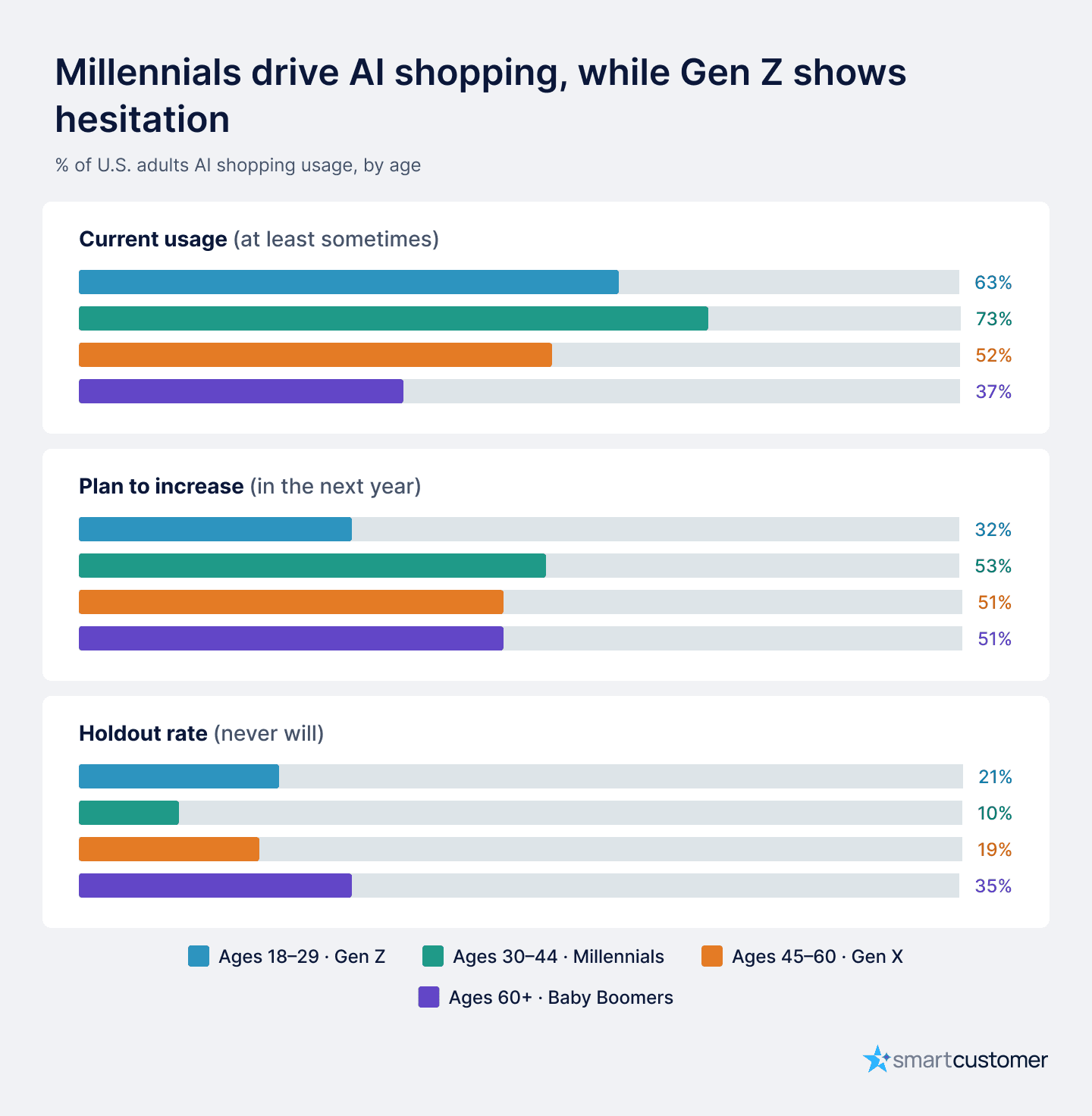
The Gen Z 18- through 29-year-old cohort that say they never intend to use AI for shopping at a rate (21%) statistically indistinguishable from Gen X 45- through 60-year-olds (19%) — a generation usually assumed to be far less comfortable with AI. In contrast, only 1 in 10 (10%) of the millennial 30- through 44-year-old respondents never plan to use AI, which is interestingly less than half the holdout rate seen among Gen Z. More than a third of respondents ages 60 and over (35%) never plan to use AI.
Conclusion
The majority of online shoppers are using AI shopping tools. And even though most survey respondents don’t fully trust it yet and about a third have regretted purchases, nearly half expect to use AI even more over the next 12 months. Rather than waiting for AI companies or retailers to earn their confidence first, most shoppers are checking AI’s recommendations against reviews and their own research. Shoppers question whether AI itself is reliable, and more than half also believe businesses are feeding it false or misleading information to influence its recommendations. In short, while AI has become part of the shopping journey, customers remain wary of information and reviews and have regrets, and it hasn’t replaced the human-verified sources shoppers relied on before its existence.
Methodology
Findings are based on an online survey of 1,181 U.S. consumers conducted in August 2026, fielded through a panel provider that uses census balancing and panel calibration checks to ensure respondents are representative of the broader U.S. population.
About SmartCustomer
Founded in 2006, SmartCustomer is a mission-driven organization with a proven commitment to bringing honesty and transparency to any online purchase. We’ve helped over 200M buyers make smarter purchasing decisions. SmartCustomer amplifies real voices so everyone can find and share feedback on businesses and their products online. SmartCustomer is the only review platform to be both funded by the US government’s National Science Foundation and an official Google review partner.
For media inquiries, please contact [email protected]