


TLDR
- Fake reviews often look legitimate, but suspicious patterns in the activity surrounding them can signal manipulation.
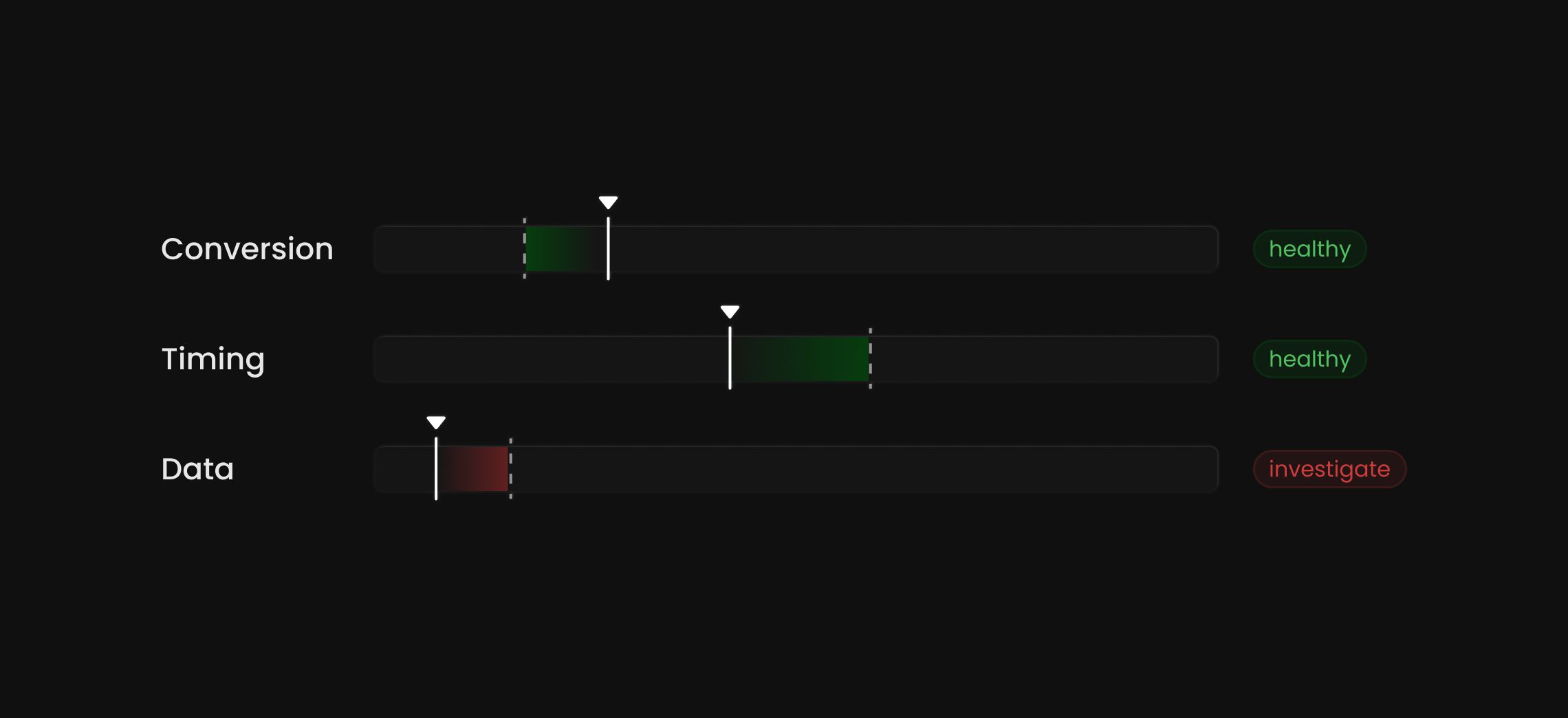
- Indicators of possible manipulation include suspicious email addresses, unusually high review conversion rates, unusual review timing, the same reviewer or groups of reviewers appearing across businesses, reviews that sound remarkably similar, vague and shallow reviews, sudden changes in businesses’ review activity, reviews that don't appear to match the customer experience, reviews that suddenly become almost universally positive, and incentivized reviews.
- SmartCustomer analyzes multiple signals together to help protect review integrity
Fake reviews don’t always look fake. Sometimes, a review contains clear signs that it may not be genuine; however, an individual review often appears legitimate. AI has only made the problem harder to spot, giving fraudsters a scalable way to write reviews that read like real customer experiences. But potential signs of a fake or manipulated review often emerge from patterns in the activity surrounding it, not from the review itself.
For more than 20 years, SmartCustomer has hosted an online consumer review and protection platform that now includes more than 24 million reviews, which gives it a uniquely informed view of how fake reviews work. Our moderation team regularly investigates review campaigns that raise questions about authenticity, and certain patterns appear again and again, including in the way businesses ask customers for reviews. None of these signals automatically means a review is fake, but when several appear together, they can provide important context for an investigation.
The following are the most common patterns we have identified.
1. Suspicious or Unusual Email Addresses
One of the first places irregularities can show up is in the customer information associated with solicited reviews. A legitimate business can have customers using virtually any email provider, so an unfamiliar email address isn’t suspicious on its own. What matters is the pattern across the customer list.
Some examples that may warrant a closer look include:
- Highly similar email addresses: Large numbers of addresses follow the same naming convention or have a repetitive pattern (for example, johnsmith01 [at] gmail [dot] com, johnsmith02 [at] gmail [dot] com, johnsmith03 [at] gmail [dot] com).
- A concentration of addresses from one provider: A disproportionate share of a customer list uses the same email provider, particularly when the provider is uncommon for the business’s typical customer base (for example, email addresses ending in “.ru” are paired with reviews claiming to be from U.S. customers).
- Lesser-known email providers: A significant number of addresses come from an obscure provider that isn’t commonly associated with the business’s customer base.
- Disposable email addresses: Multiple customers use temporary email services that are designed to provide short-lived email addresses.
- Patterns across multiple uploads: Similar email address characteristics continue to appear in customer lists over time rather than occurring as a one-time anomaly.
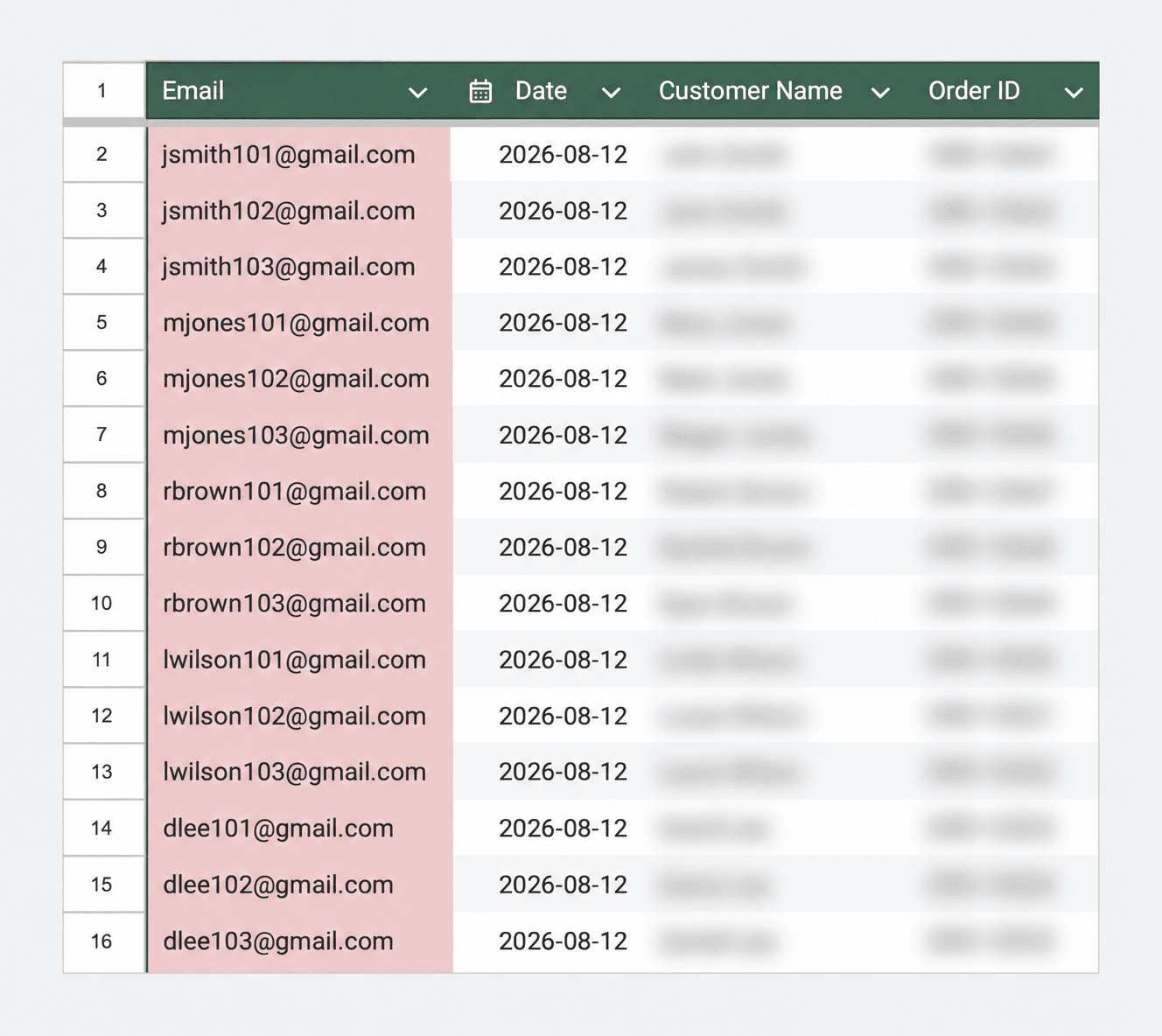 Mock data for illustration purposes. Data used are fictional.
These characteristics don’t automatically mean that a customer isn’t real. People use lesser-known email providers, alternate email addresses, and temporary addresses for legitimate reasons. What raises concern is the combination, scale, and context of the patterns.
2. Unusually High Review Conversion Rates
Another signal we investigate is how frequently customers respond to review invitations. A high conversion rate isn’t inherently suspicious. Some businesses do have extremely engaged customers or particularly effective review-request campaigns. But legitimate customers don’t all behave the same way. Some respond immediately, some wait a while, some intend to respond and never do, and many simply ignore review requests altogether.
That's why a campaign in which an exceptionally high percentage of invited customers leave reviews can sometimes warrant additional investigation, particularly when other unusual patterns accompany the conversion rate.
For example, we may look more closely when a campaign has:
- Conversion rates that change dramatically from the business’s historical activity
- Very high conversion combined with suspicious customer email patterns
- Very high conversion combined with tightly clustered review timing
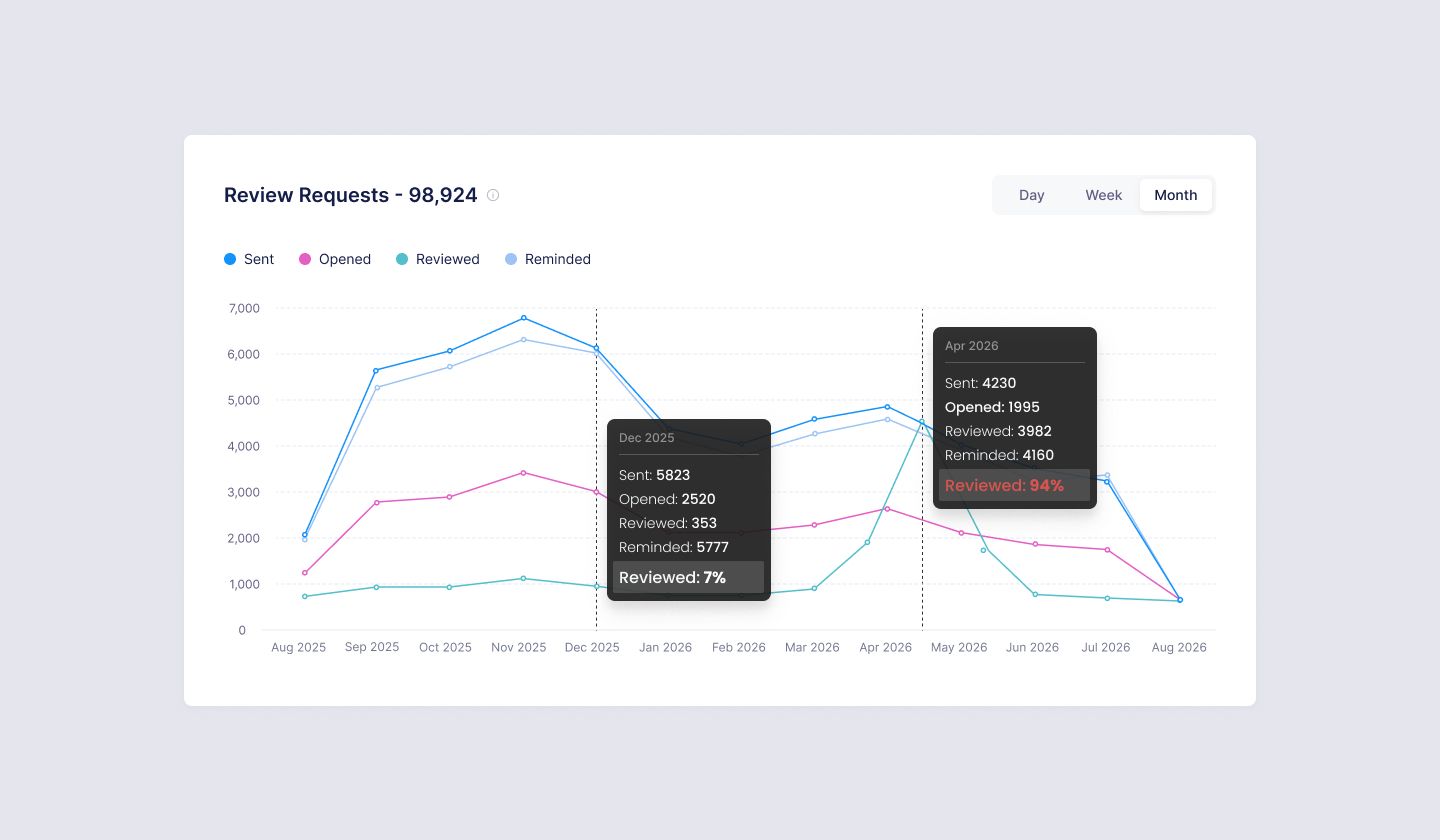 Mock data for illustration purposes. Data used are fictional.
In the above example, the business’s conversion rate remains relatively consistent throughout the period, generally falling within a normal range. Then, in April 2026, the rate suddenly jumps to 94%, with nearly every invited customer leaving a review. That kind of dramatic break from the business’s historical pattern is worth investigating.
3. Unusual Review Timing
Review timing can vary widely, and some customers never respond to requests. But when reviews arrive in tight clusters or at oddly regular intervals, we take a closer look. Examples include:
- A large number of reviews submitted within a very short period
- A surge of customers submitting reviews almost immediately after receiving an invitation
- Reviews submitted at too evenly spaced intervals or within nearly identical timeframes
- A significant change in the timing or distribution of reviews compared with the business’s historical pattern
These patterns can have legitimate explanations. A product launch, promotion, seasonal sales spike, or change in the way a business collects feedback can naturally affect when reviews arrive. As with every signal on this list, timing carries more weight when it appears alongside others.
4. The Same Reviewer or Groups of Reviewers Appearing Across Businesses
Sometimes the most revealing signals and patterns emerge across businesses, not within a single business. For example, when viewed in isolation, a reviewer may appear legitimate. She might have a plausible name and email address and her review seems authentic.
But if that same reviewer or groups of reviewers appear across multiple businesses with suspicious activity, the additional context can become significant.
Our moderation team looks for patterns such as:
- The same reviewers appearing across multiple businesses within a similar timeframe
- Groups of reviewers appearing across the same businesses or campaigns
- A reviewer with little or no prior activity suddenly reviewing numerous businesses in a short period
Some people leave reviews frequently and across many businesses. The concern arises when repeated reviewer activity becomes part of a larger pattern of questionable behavior.
5. Reviews That Sound Remarkably Similar
The content of the reviews themselves can also raise a red flag.
Reviews from genuine customers don’t have to sound completely unique. Customers buying the same product or using the same service may naturally mention similar features or experiences, or use similar terminology. However, when a group of reviews shares the same language, structure, phrasing, or descriptions, that overlap is worth examining.
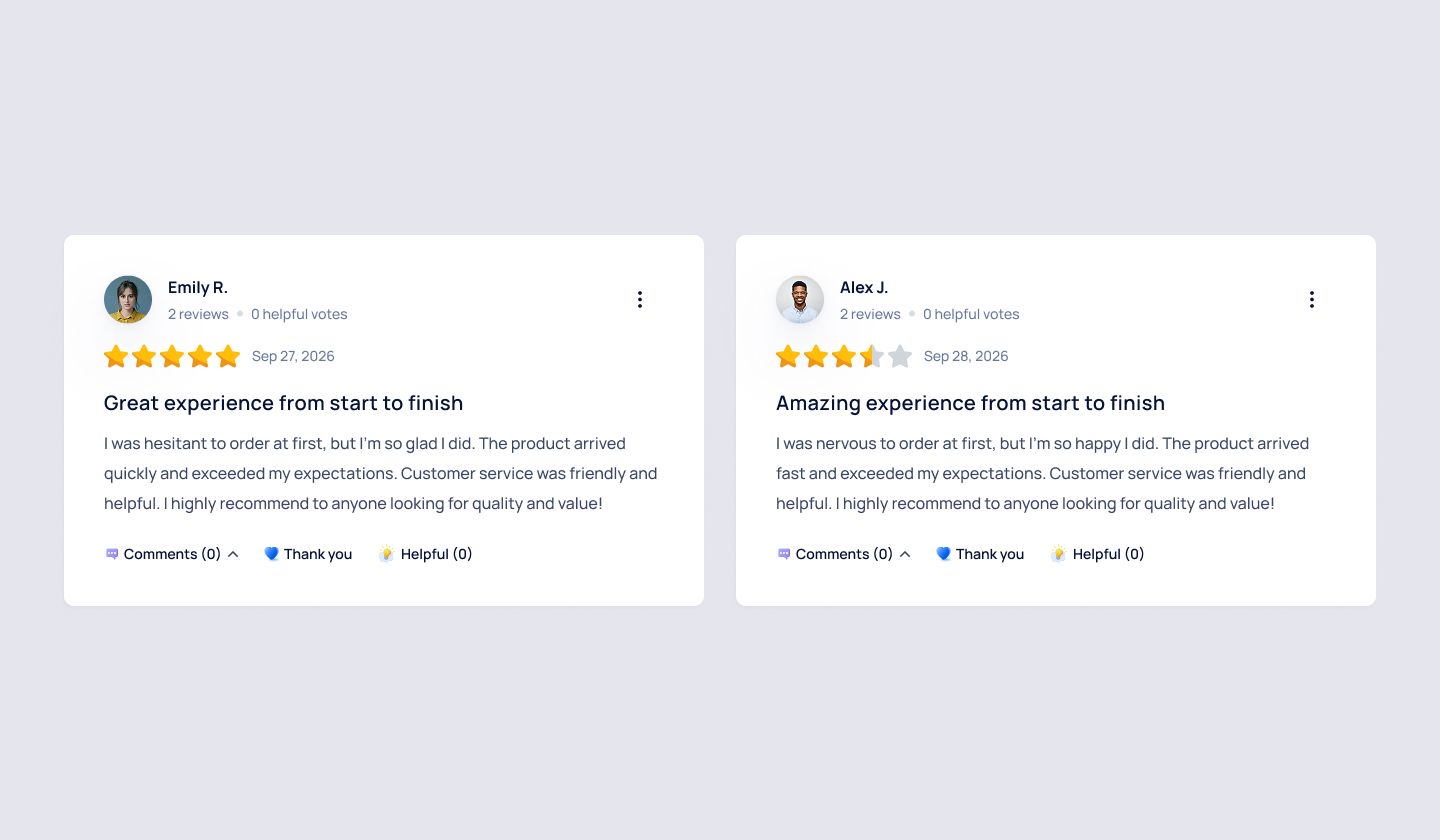 Mock data for illustration purposes. Data used are fictional.
We review the data for:
- Repeated phrases appearing across multiple reviews
- Reviews following nearly identical structures
- Reviews that appear to have been produced from the same template
- A sudden change in writing style compared with how customers typically talk about the business
- Different reviewers sharing the same distinctive phrases
This behavior in particular has spiked as generative AI becomes more widely available. A real customer may use AI to organize their thoughts or make a review easier to read by correcting their grammar and syntax. Using AI for help doesn’t mean a review is fake. The concern is when a large group of reviews exhibits a pattern suggesting they were created or heavily influenced in a similar way.
6. Vague and Shallow Reviews
Some reviews offer vague praise (“Great restaurant!”) or a recommendation with no meaningful details about the product or customer experience. It's not uncommon for genuine customers to leave brief reviews.
However, these reviews become more of a concern when a large share of a business’s reviews are equally generic, repeat the same wording, or give little indication that the reviewer actually interacted with the business.
7. A Sudden Change in a Business’s Review Activity
A significant change in a business’s review activity can be another signal worth examining. For example, a business that normally sends out a steady stream of review requests might suddenly begin sending out significantly more invitations.
There are many legitimate reasons for influxes, including:
- A substantial increase in sales
- A new product launch
- A successful marketing campaign
- Seasonal shopping activity
- A change in how the business asks customers for feedback
- A migration to a new e-commerce or customer-management platform
Even so, unexpected changes in review activity may prompt further investigation as a necessary precaution. And analyzing historical activity provides important context because what is unusual for one business may be completely normal for another.
8. Reviews That Don't Appear to Match the Customer Experience
The content details of reviews also provides telling context. Reviews may raise a red flag when they describe a product, service, location, transaction, or interaction that doesn’t align with the business’s actual offerings or the reported customer experience.
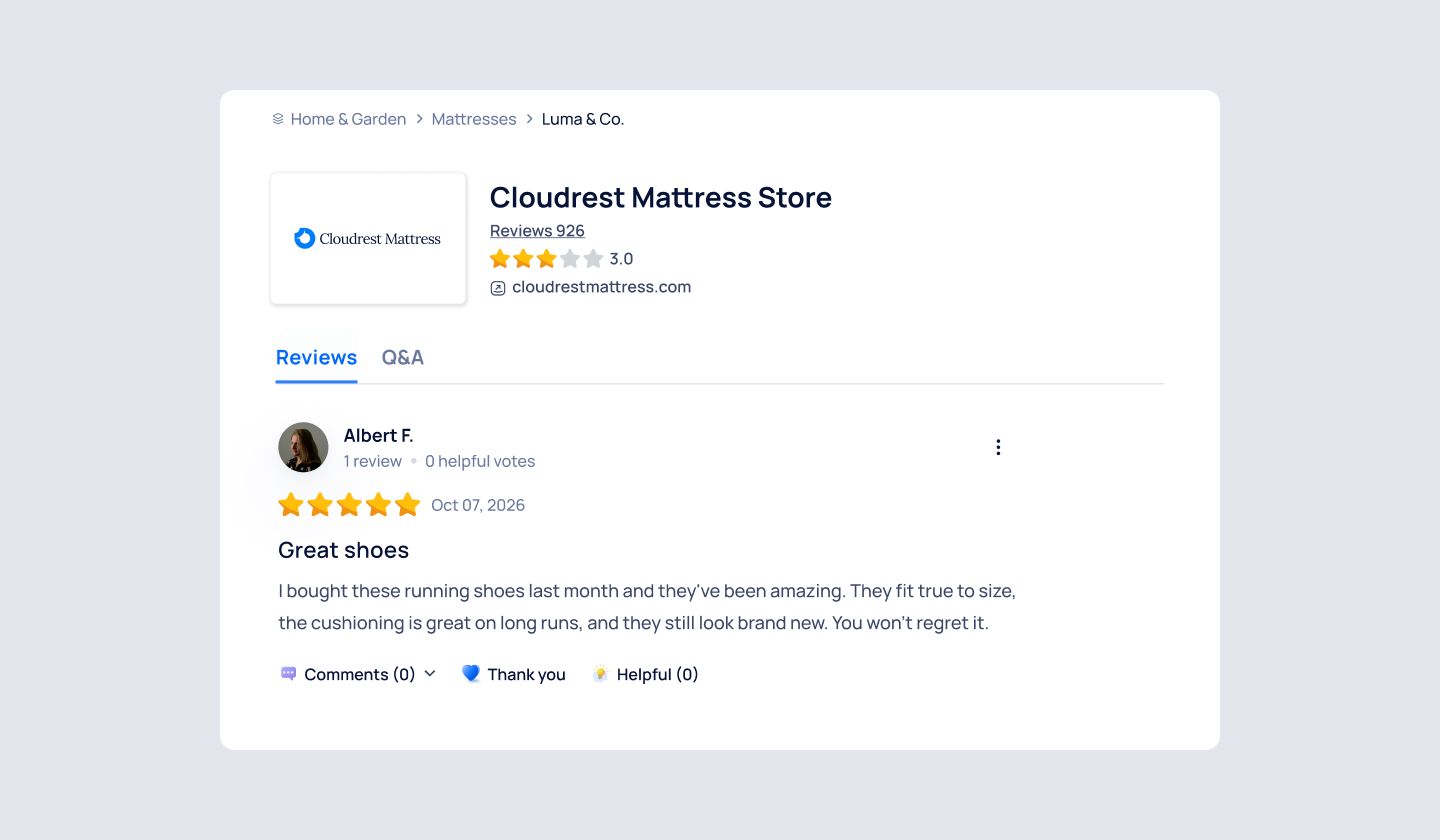 Mock data for illustration purposes. Data used are fictional.
Examples might include:
- Mentioning products or services the business doesn’t offer
- Describing an interaction that appears impossible based on the business’s operations
- Repeatedly using details that don’t match the business
- Multiple reviews containing the same factual inconsistencies
These cases may be easier to evaluate because the review provides details that can be checked against other evidence.
9. Reviews That Suddenly Become Almost Universally Positive
Excellent products and services often earn enthusiastic, positive reviews. But it’s a red flag when a business that previously received a mixture of positive, neutral, and negative feedback suddenly begins receiving a surge of uniformly positive reviews. If this pattern emerges, it’s important to get more information and context about how the business collects reviews (for example, if there is evidence that the business is discouraging negative experiences or selectively encouraging positive reviews).
The concern isn’t that a business has a preponderance of five-star reviews. It's whether the way those reviews were generated appears consistent with independent customer feedback.
10. Incentives or Other Attempts to Influence the Review
Not every manipulated review involves a fabricated customer.
Sometimes the customer is real, but the business has influenced the review in some way. For example, businesses may attempt to offer incentives in exchange for positive business reviews or ask customers to remove negative reviews in exchange for refunds or replacements. Or they might even make customer service contingent on the review outcome.
For business reviews on SmartCustomer, offering an incentive in exchange for a review isn’t permitted. Customers should be able to share their experience without being rewarded for saying something positive or punished for saying something negative.
This policy is particularly important because manipulation doesn’t always look like a fake five-star review. Sometimes it involves a genuine customer who was pressured into changing their opinion. That distinction is one reason review moderation has to consider the circumstances surrounding a review, not just the review itself.
The Most Important Pattern: Multiple Signals Together
None of these patterns, on its own, necessarily indicates a fake review. A Hotmail address, high conversion rate, prolific reviewer, short-term cluster of reviews, or AI-assisted writing may each have a legitimate explanation.
But when several patterns appear together, it’s often a red flag. For example, a customer list contains hundreds of similarly formatted email addresses, most using the same obscure provider; nearly all of those customers leave reviews; many reviews appear within a narrow window; several reviewers also appear to have reviewed other businesses showing similar patterns; and the reviews themselves read almost interchangeably. Fake reviews rarely reveal themselves through one obvious clue. More often, they emerge from the relationships among seemingly unrelated pieces of information.
Therefore, SmartCustomer's moderation process doesn’t rely on a simple checklist where a single anomaly automatically results in a review being removed. Our team evaluates the available evidence, considers legitimate explanations, and analyzes how different signals relate to one another before determining whether additional action is required.
Real customers are unpredictable, and legitimate businesses aren't all going to have the same review patterns. Legitimate review activity doesn’t necessarily look perfectly uniform. SmartCustomer’s goal is to recognize patterns that go beyond normal customer behavior and may warrant a closer look.
Why This Matters to Consumers
Consumers generally see only the final review and rating, while the underlying activity and processes that produced them remain largely hidden. For example, they don't see whether the same reviewers appeared elsewhere or whether the language across a group of reviews repeats the same verbiage.
Consumers don’t know, or necessarily need to know, about every investigation that takes place. But understanding that these checks exist can help consumers think more critically about the reviews they rely on when making purchasing decisions. Trust comes from knowing there are processes in place to identify potential manipulation and protect the integrity of the review ecosystem.
At SmartCustomer, this work happens behind the scenes. Sometimes it means confirming there’s a legitimate explanation for what appears to be an unusual campaign. Other times, it means identifying a pattern that can't reasonably be explained by genuine customer behavior and taking appropriate action. Either way, the goal is to help ensure that the reviews consumers and businesses rely on reflect authentic customer experiences.