

The automobile took 25 years to reach 100 million adopters. The internet took 15 years. Facebook took 4 years. ChatGPT? Two months.
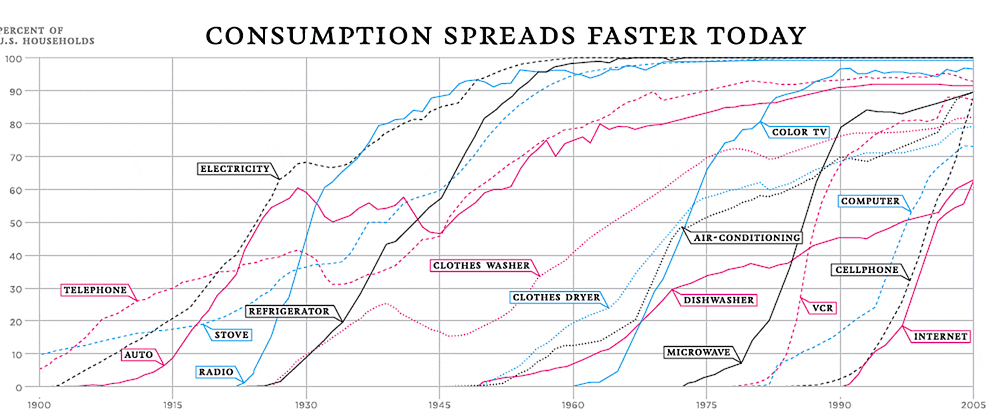 Source: Nicholas Felton
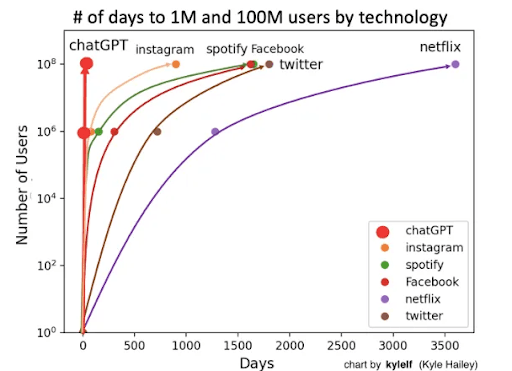
And now, ChatGPT alone attracts 800 million weekly visits. This isn't just a technological shift; it's a fundamental change in consumer behavior.
Nearly 60% of consumers now use AI search platforms like ChatGPT or Gemini to shop online. They (or should I say we?) are using more conversational, natural language searches, and this new habit is creating a different kind of buyer journey.
This new landscape requires new strategies, which many refer to as Answer Engine Optimization (AEO). I’ll break down the latest research into how AI recommends products and services, what AEO is, and the steps you can take to help your brand appear in AI search.
AI Traffic Converts Better
A recent Pew Research Center study revealed that users click almost two times less on traditional links when AI Overviews are present. Many of us are experiencing this zero-click world, where AI provides high-quality answers for top-of-funnel queries, and now, even transactional.
However, the traffic that does come through from AI platforms is highly valuable. An analysis of 12 million website visits showed that AI traffic converts at an astonishing 14.2%, which is 4-5x higher than Google's average of 2.8%.
Why? When someone arrives at your site from an AI recommendation, they're not just browsing. They've already had a conversation, compared alternatives, and refined their requirements through dialogue with an AI assistant. They’re not at the top of your funnel, they’re near the bottom, credit card in hand, ready to buy.
This isn’t about AI stealing Google’s traffic. It’s about a shift toward a better discovery and buying experience: time saved, easier navigation, and personalized product recommendations. AI doesn’t just find information. It understands context, remembers preferences, and delivers responses that feel like talking to a knowledgeable friend.
Traditional search sent you researchers who could be at any point of the funnel. AI search sends you buyers.
How AI Models Learn
To understand how AI decides what to recommend, it’s essential to have a basic knowledge of how these models work. Let’s focus on ChatGPT, since it’s the current most widely used platform.
ChatGPT provides answers in two main ways:
1. Native Knowledge Base
The base models are initially trained on public datasets like CommonCrawl, a nonprofit that continuously crawls the web and publishes open data dumps. Other large public datasets may have also been used. ChatGPT’s large language learning models go through these vast datasets with specialized algorithms for quality and relevance.
Through neural nets and deep learning, ChatGPT develops the ability to predict what should come next in any given sentence, extracting patterns and relationships from massive amounts of text data.
2. Live Search (Retrieval-Augmented Generation / RAG)
When the AI doesn’t know the answer or thinks it can form a better answer with newer info, it searches the web in real time to supplement its knowledge base. This is called Retrieval-Augmented Generation (RAG), allowing the AI to pull up-to-date information, such as reviews, articles, or newly published content, before generating a response. So, how does an AI decide which brands to recommend? Let’s dig into the latest data.
What the Research Says
We’ve analyzed some important recent studies on AI recommendation factors. Here’s how the evidence stacks up.
Brand Mentions vs. Brand Citations
Let’s first distinguish two key concepts:
Brand Mentions: Name-drops of your brand, regardless of linking.
Brand Citations: Direct references or links to your website as a trusted source.
Mentions build awareness and set the stage for recommendations. Citations prove the AI trusts your content and authority for a topic.
People Need to Be Talking About You
Ahrefs analyzed millions of AI Overview responses to find mentions of 75,000 brands, then ran it against their massive database of domain and keyword factors. The results should fundamentally change how you think about establishing a brand:
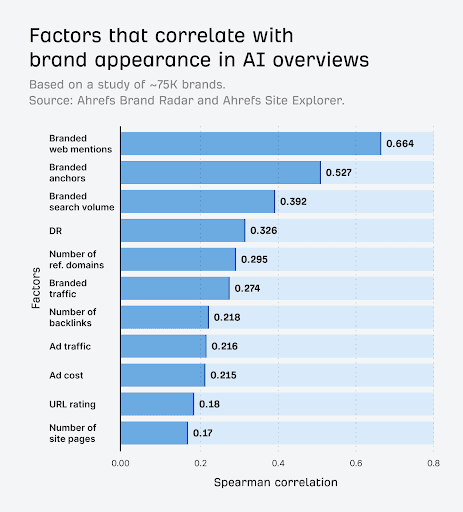
- Branded web mentions (0.664 correlation) - Whether linked or unlinked, mentions of your brand across the web show the highest correlation with brand presence in AI Overviews.
- Branded anchors (0.527) - No surprise here, whether other domains link to your brand still matters.
- Branded search volume (0.392) - Your brand popularity, or the number of people who actively search for your brand, was the third most significant factor.
In short: the more frequently your brand is referenced or discussed across the web, the higher your chance of being surfaced by AI.
Popularity Matters
Marketing guru Kevin Indig conducted a rigorous analysis of 7,000+ brand citations across 1,600 URLs in ChatGPT, Perplexity, and Google AI Overviews. After testing many variables against AI chatbot visibility, one finding was clear: brand search volume is the strongest single predictor of AI mentions. On a platform-by-platform basis, ChatGPT in particular exhibits the strongest bias toward popular brands.
The same study also found a tight connection between brand associations and the topic of questions users ask. AI understands brands in the context of specific categories and topics. Your brand doesn't exist in isolation; rather, it exists within conversations about specific problems, needs, and product categories.
And when Indig assessed which specific website factors increased citation rates in AI chatbots, he found traditional SEO metrics like domain authority and page rank had weak correlations. Instead, higher word and sentence counts were stronger predictors, suggesting that AI models emphasize richness and contextual depth.
Freshness is Critical
A team from Waseda University in Japan conducted a fascinating experiment. They took a large dataset and added fake publication dates to passages, then tested how seven different major AI models ranked them.
The results:
- The top 10 results were consistently 1-5 years newer
- Individual passages moved 61-95 positions based purely on date
- AI models reversed 8-25% of relevance judgments when freshness changed
- Older authoritative content was systematically demoted in favor of newer content
Additionally, SEO consultant Metehan Yesilyurt found in ChatGPT's configuration a specific freshness scoring parameter that he claims isn't just a minor ranking signal, but one that could be powerful enough to override content quality signals.
Third-Party Sources Dominate
In an AirOps study (500+ commercial-intent queries across six verticals at the brand discovery stage), the evidence is overwhelming: 85% of branded mentions in AI answers come from third-party sources. Brands are 6.5 times more likely to be cited from authoritative third-party domains than from their own content.
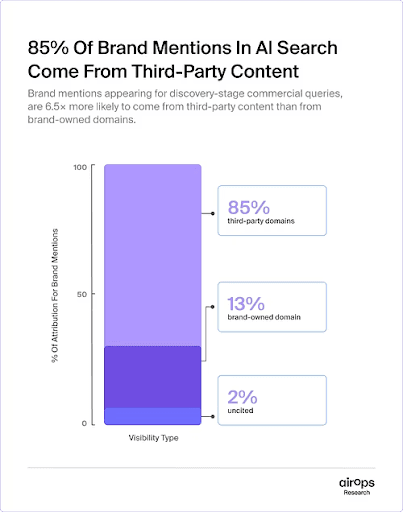
What others say about you matters more than what you say about yourself. The collective voice of the crowd is training the AI, and that, in turn, drives your brand's visibility.
What This Means for Answer Engine Optimization (AEO)
Bottom line: we are in a reputation economy, and conversation is the new currency.
AEO is the practice of increasing your brand's visibility and improving sentiment within AI-generated answers. It’s not about gaming an algorithm but about building a powerful and widespread digital reputation. The goal is to get your brand mentioned and cited in AI search.
Now that we understand how AI models learn and what drives recommendations, let's talk about what you can actually do about it.
1. Build Offsite Authority Through Conversations
Third-party sources drive the vast majority of AI recommendations. That means your top priority should be to get people talking about your brand across the internet.
Customer reviews are a goldmine for AEO. A study by Nectiv (8,500+ prompts across 9 verticals) found the word “reviews” is by far the most common ChatGPT query term for answers. AI parses reviews for sentiment, keywords, and competitive comparisons.
Actionable Steps:
- Encourage Reviews: Use automated workflows to consistently prompt customers for public feedback.
- Distribute Feedback: Don't let reviews sit siloed on one platform. Actively prompt customers to leave reviews on platforms that matter in your industry, which usually includes Google Business Reviews, SmartCustomer, and BBB.
- Engage with Communities: Join relevant forums and participate in authentic conversations. Value-driven answers become the training data that shapes AI results.
Get reviews across channels that matter to you with SmartCustomer →
2. Generate Conversations About You, Consistently
Results from the Waseda study are clear: fresh, recent content is consistently prioritized, sometimes even when older content comes from a longer-standing legacy source.
But updating your own site isn’t enough. You must be the topic of an active, ongoing conversation across diverse digital platforms where AI sources its signals.
3. Develop Topical Authority
AI associates brands within the context of categories, problems, and product types (Kevin Indig’s Research). To position your brand as the “best answer,” you need to show up in relevant conversations, collaborate with authoritative voices, and strategically answer common questions.
Key strategies include:
- Sparking industry discussions and user-generated content across relevant platforms.
- Building relationships with other authoritative voices in your space.
- Establishing thought leadership.
- Consistently producing content that addresses core questions in your category.
- Utilizing schema markup so AI can easily parse and categorize your website content.
4. Optimize Your Website for AI Crawlers
Once you surface in AI answers, you need to convert the high-intent traffic. Optimize for both human visitors and AI bots.
Actionable Steps:
- Don’t block GPTBot or other AI crawlers in your robots.txt
- Prioritize load times. Faster content is favored by all search algorithms.
- Clear and accessible structure aids both AI and user journeys.
- Display UGC on home and product pages to build trust with both AI and humans.
Closing Thoughts
AI search is rewriting the rules of digital marketing. Traditional SEO tactics are no longer enough.
There’s no “hack” to game the system. We're entering an era where AI is providing genuinely better experiences for end customers, and businesses need to become the best answer, not just the most optimized answer.
It's no longer about what you say on your website. It's about what everyone else says about you, everywhere else online. The voice of the crowd trains the machine, and the machine decides your visibility.
Here's the opportunity hidden in that challenge: if you're genuinely excellent at what you do, if you're creating real value for customers, if you're earning authentic advocacy, you now have a direct path to visibility that doesn't require outspending competitors on ads or outsmarting algorithm updates.
Start by focusing on what your customers are saying about you. Amplify their voices, engage in the communities where they gather, and build a brand that AI models can't help but recommend.
You can start getting your conversations going and boost your brand's visibility with reviews. Learn how with SmartCustomer →
References
Gelman, A. (2012, April 8). Technology speedup graph. Statistical Modeling, Causal Inference, and Social Science. Retrieved from https://statmodeling.stat.columbia.edu/2012/04/08/technology-speedup-graph/
Paruschke, A. (2023, February 17). Chat GPT | Mass market adoption within days. . . https://www.linkedin.com/pulse/chat-gpt-mass-market-adoption-within-days-alexander-paruschke/
Bloomreach (2025, March 6). “More Than 60% of Consumers Have Used Conversational AI for Shopping, New Research From Bloomreach Finds.” Business Wire, https://www.businesswire.com/news/home/20250306456682/en/More-Than-60-of-Consumers-Have-Used-Conversational-AI-for-Shopping-New-Research-From-Bloomreach-Finds.
Oldshue, H. (2025, September 18). AI Search Traffic Converts 5x Better Than Google: 2025 Conversion Data from 12M Visits. Superprompt.com. https://superprompt.com/blog/ai-search-traffic-conversion-rates-5x-higher-than-google-2025-data
Linehan, L. (2025b, August 26). An analysis of AI Overview brand visibility factors (75K brands studied). SEO Blog by Ahrefs. https://ahrefs.com/blog/ai-overview-brand-correlation/?utm_source=strategybreakdowns.com&utm_medium=referral&utm_campaign=how-ahrefs-is-winning-ai-search
Indig, K. (2025, March 17). What content works well in LLMs? Growth Memo. https://www.growth-memo.com/p/what-content-works-well-in-llms
Fang, H., Tao, S., Chen, N., Chang, K., & Sakai, T. (2025, September 14). Do large language models favor recent content? A study on Recency Bias in LLM-Based Reranking. arXiv.org. https://arxiv.org/abs/2509.11353
Yesilyurt, M. (2025, October 3). I Found It in the Code, Science Proved It in the Lab: The Recency Bias That's Reshaping AI Search -. AI & SEO Fundemantals. https://metehan.ai/blog/i-found-it-in-the-code-science-proved-it-in-the-lab-the-recency-bias-thats-reshaping-ai-search/
Davidson, O. (2025, October 17). Third-party sources drive 85% of brand mentions in AI search: AirOps Report. AirOps. https://www.airops.com/report/the-influence-of-offsite-signals-in-ai-search
Cooke, H. (2025, September 11). Humans skim, machines scrape: AI search and brand discovery - MediaCat UK. MediaCat UK. https://mediacatmagazine.co.uk/humans-skim-machines-scrape/
Long, C. (2025, October 14). New data study: What queries is ChatGPT using behind the scenes? Nectiv. https://nectivdigital.com/new-data-study-what-queries-is-chatgpt-using-behind-the-scenes/
OpenAI. (n.d.). Bots. OpenAI Platform, from https://platform.openai.com/docs/bots
OpenAI. (2025, September 29). Buy it in ChatGPT: Instant Checkout and the Agentic Commerce Protocol from https://openai.com/index/buy-it-in-chatgpt/